7 key quotes from The Delivery Conference 2026
- 9 February 2026
- Ben Sillitoe

Key Takeaways
- Delivery and fulfilment are now core to customer trust
- Retail supply chains must be agile to manage constant disruption
- End-to-end supply chain optimisation drives efficiency and resilience
What do Nespresso, Monica Vinader, Liberty, H&M, The Cheeky Panda, Kingfisher, Selfridges, New Look, On, Superdry, and Decathlon have in common?
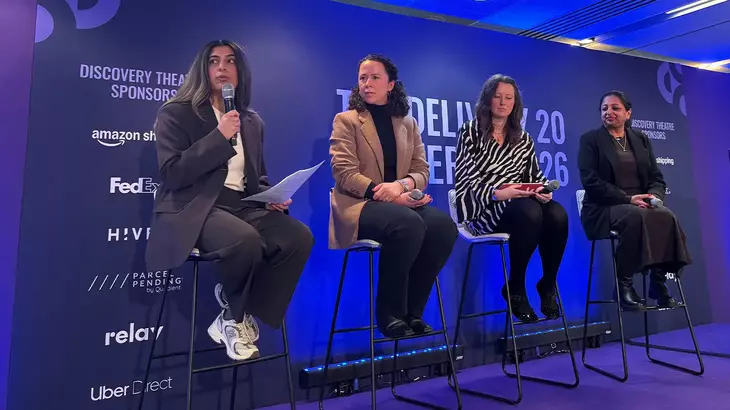
Aside from the fact, they’re all retail businesses – they were also all represented on stage at this year’s The Delivery Conference (TDC) in London, which was brought to the industry by our friends at Metapack and Shipstation parent company Auchane.
From AI’s impact on retail and the supply chain, to best practice in returns management, customer communication, and wider supply chain orchestration, all the big issues were raised. Many of which are subjects close to Manhattan Associates’ hearts.
Dashing from session to session to hear from retailers about what it’s like at the coalface, as they front up to ever-changing consumer demands, a genie’s lamp of new technological capability, and the prospect of extra cross-border levies in 2026, I picked out seven quotes that I think – together – help illustrate where retail is right now.
Liberty on the unforgiving customer
The most important thing in retail: the customer. Without them, there is no business.
Speaking on a panel, Kam Chadha, customer services manager at Liberty London, said: “Customer expectations are rising and there is zero room for mistakes for all retailers and delivery companies.
“Customers are far less forgiving if something has gone wrong because they expect speed, transparency, and visibility – all of those things – as standard.”
She also noted customers “won’t remember a seamless delivery but if something goes wrong they’re quick to pick up the phone or email saying they expected more”, which underlines the importance for retailers to get the supply chain infrastructure in place for fulfilment success.
The Cheeky Panda on risk management
We live in unusual times, and each year there’s something new to disrupt.
The Cheeky Panda co-founder Chris Forbes, whose company was founded in 2016, alluded to this, saying before 2020 ‘Black Swan’ events probably occurred every decade but they’re now more frequent.
“We see a black swan event every year now, if not every six months. You’ve got to plan for the unexpected – and that means agility in your thinking, agility in your supply chain, and agility in your technology.”
He added: “Lots of businesses don’t survive through these seismic changes, so you’re risk management has to be really hot in terms of expecting the unexpected.”
Selfridges on retailer-supplier relationships
Retailers can’t achieve everything they want to achieve alone; they need partners, but not just any old partners. Forbes spoke of the success The Cheeky Panda has experienced by streamlining partnerships, but Selfridges’ head of supply chain Amy Allen was particularly erudite in her description of what makes strong collaboration.
“Suppliers that have a curiosity to look into the way you’re operating and strive to continuously improve – that is a real unlock for me,” she told TDC delegates.
“I’m looking for partners now that want to understand why are there so many claims, failed deliveries etc – and to find new problems and find the resolution together or introduce me to other partners in the industry who might be able to solve the problem we have identified.”
She said under her leadership in the supply chain space, Selfridges wants to find partners that can help find “incremental value-added opportunities” because this is what contributes to partnership longevity.
“The climate is tough and everyone in my shoes will be looking to squeeze as much commerciality out of every opportunity and looking to get as many savings on the P&L as possible especially as the market is challenging.”
Tradecart and ‘on-demand’ expectations
I was really interested to hear TradeKart founder Alistair McAuley talk about his business, which was founded in 2021 and works alongside Uber Direct to connect merchants to tradespeople, on demand.
His outlook on the future of how tradespeople will operate reflects wider retail in many ways, and has major implications for supply chains and the use of the store in online order fulfilment.
“The next generation of tradespeople are digitally savvy, they’re going to want things at the touch of a button and they’re going to realise the cost of going to a store is going to massively outweigh the cost of goods being delivered to them,” he argued.
“I think the biggest footfall in the trade community – in every merchant in the UK – within the next three years will be the collection driver not the tradesperson.”
Nespresso on customer trust
Delivery used to be a back-end operations piece of the retail operation, but as e-commerce has grown to approximately a quarter of retail sales in the UK, it’s become an area of strategic and customer experience (CX) importance.
Nespresso UK’s head of customer experience Gabriela Lambert said: “Delivery is no longer the end of the sentence; it’s intrinsic to customers choosing to buy with you or not to buy with you.”
She also noted: “Delivery is super aligned with customer trust and what they expect from you as a brand, so it’s an intrinsic part of the CX you have to get right so they feel a sense of trust that you will always do what you say you will do.”
New Look on communicating returns
Consumers – or shoppers, as Mary Portas told TDC’s audience she prefers to call them because it makes them sound more human – are already thinking about the returns process before they make a purchase. So it’s an area of retail that needs huge focus.
New Look customer optimisation manager Daniele Thomas said: “The post purchase part of the journey is part of customers’ consideration before they commit to a brand.
“Quite often they buy multiple outfits or they’re buying more than one size so they are already thinking about the return before they have converted.”
Thomas suggested the comms around returns needs to flow throughout the journey. “If comms around the returns process isn’t optimal or well timed, that silence in communication can just cause risk and anxiety in the customer; they feel lack of control.”
H&M on end-to-end supply chain optimisation
It is referenced time and time again in the supply chain community, but it was important to hear it said by a retailer: it’s crucial to consider the end-to-end supply chain when investing in technological capability or building strategic plans.
H&M’s logistics network strategic lead Kristian Tottmar remarked: “Look at efficiencies wherever in the chain that will improve your ability to deliver at precision quality.
“Find the low hanging fruit. Look at the end-to-end picture – lead time, costs, service constraints – and focus on having systems and processes to optimise it.”
Seven quotes, there, that if retailers think about in detail should give them every chance of making a success of their business in an uncertain and fast-changing world.
Representing Manhattan Associates at TDC was senior director, Martin Lockwood, who said the event offered a “high energy and a positive vibe throughout”.
“There was lots of opportunity to make new connections and also catchup with my existing network,” he said.
Better connectivity, robust networks, and positive thinking is actually a very good way of describing what’s needed in the wider supply chain commerce space in general, as new challenges and opportunities present themselves this coming year.
Everything works better with Manhattan solutions
Manhattan offers a complete breadth of solutions that when unified, provides total coverage for your supply chain commerce needs.
Warehouse management
Control demand, supply, labour and automation across your entire network with Manhattan's Warehouse Management.

Transportation management
Manage every carrier, rate, route and load with Transportation Management.

Order management
Unlock unprecedented precision, inventory visibility and promising with Order Management’s cloud-native architecture.