Why ActiveAgents Are the Right AI for Supply Chain Commerce
Manhattan ActiveAgents™ are AI agents built into Manhattan Active for supply chain commerce. They reason about a goal, pull relevant operational data, ask clarifying questions, recommend a next step and, when the workflow and permissions allow, execute the action across connected Manhattan Active solutions.
Why ActiveAgents™ Are the Right AI for Supply Chain Commerce
AI is everywhere in commerce. Copilots, chatbots and generic “agents” promise to transform the business. But supply chain teams need more than answers: they need AI that can reason from current operational data, work within defined controls and help complete the work that keeps inventory, fulfilment, labour and customer experience moving.
Manhattan ActiveAgents address that need. They are Manhattan’s productised expression of agentic AI: software that can analyse a goal, use relevant operational context, ask clarifying questions, recommend next steps and, when the workflow and permissions allow, execute actions across connected Manhattan Active solutions. The result is AI designed to move from generating answers to helping drive outcomes—not simply holding a conversation.
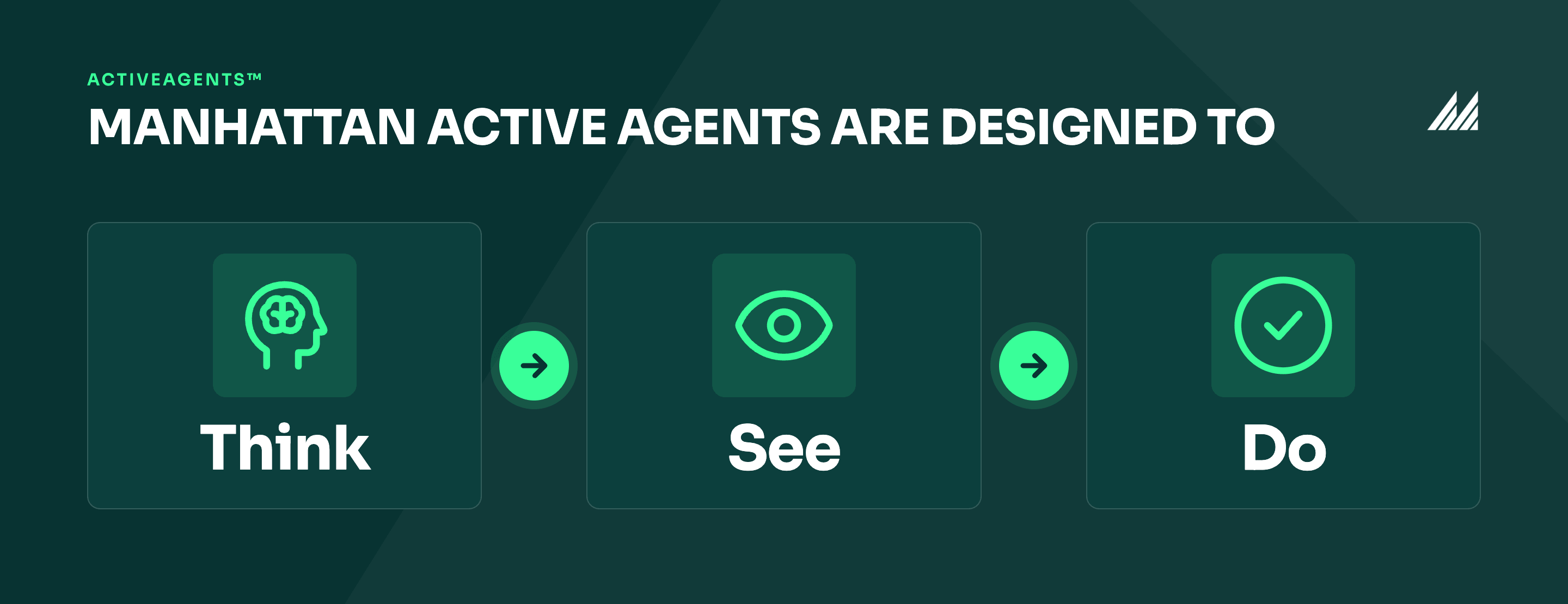
ActiveAgents bring those capabilities to supply chain commerce—the high-volume operations behind every inventory promise, shipment and customer interaction. They think by understanding the request and planning a response, see by using relevant operational data and asking clarifying questions, and do by carrying out approved actions through the tools and workflows available to them. They work alongside your people as digital members of the workforce.
This article explains why ActiveAgents stand apart: they are built for operations, grounded in Manhattan’s domain context, governed by the platform and designed to create measurable value—not just impressive AI demonstrations.
Key Takeaways
-
Built for Supply Chain Execution
Manhattan Active Agents are purpose-built for supply chain commerce, embedded directly within the unified, cloud-native Manhattan ActivePlatform to optimise inventory, fulfilment, labour, and order orchestration. -
They Act, not only Answer
These agents don’t just answer questions—they think, analyse, and execute, autonomously performing operational tasks and orchestrating multi-step workflows across supply chain systems. -
They work as a group
Multiple specialised agents collaborate across warehouses, transportation, stores, and customer service, creating a coordinated AI workforce that enhances decision-making and operational performance. -
They are governed and measurable
With built-in guardrails, transparency, and measurable performance improvements, Manhattan Active Agents deliver secure, enterprise-grade AI designed to drive real productivity gains across modern commerce operations.
AI Agents That Think, See and Execute Supply Chain Work
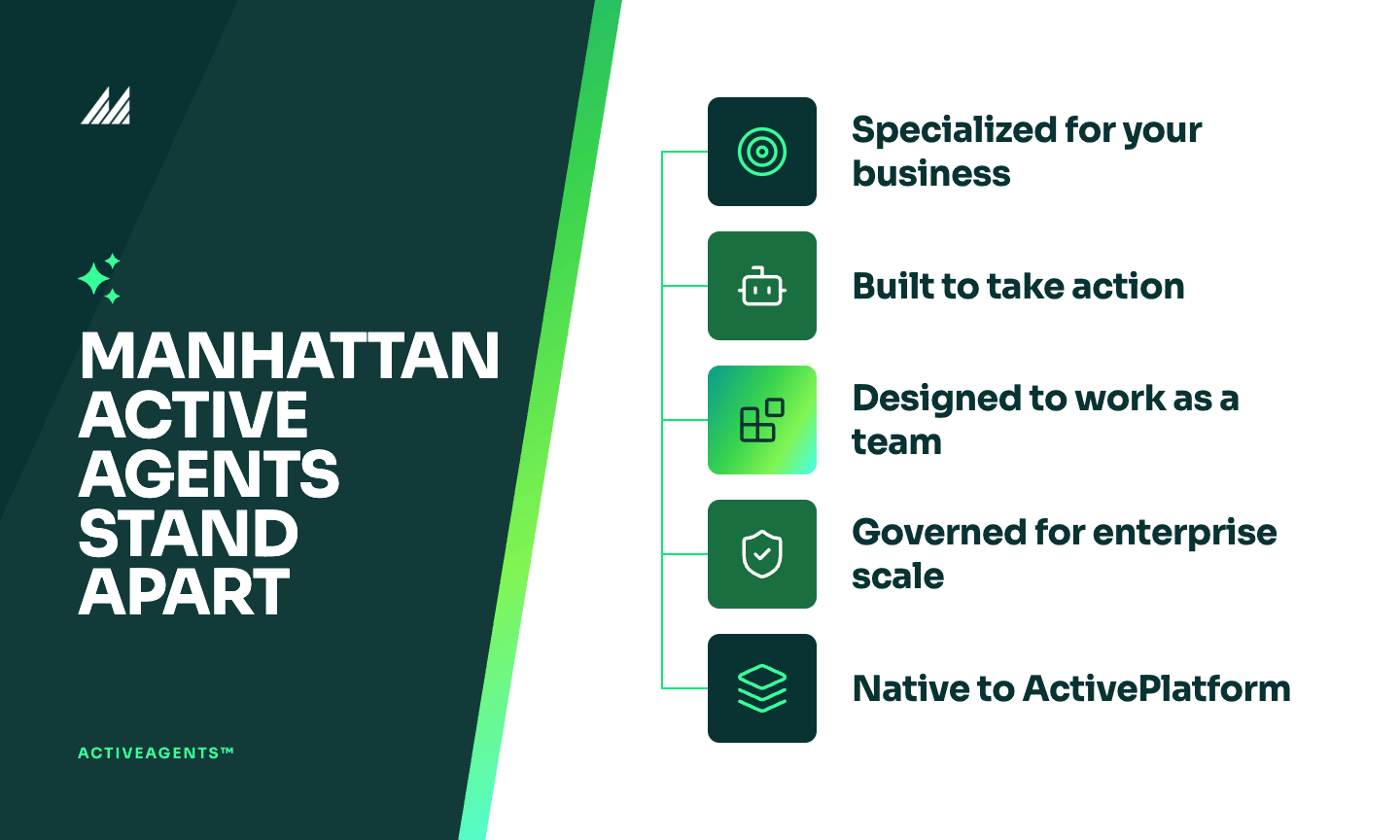
Many AI tools sit beside the systems that run the operation. ActiveAgents are built natively into Manhattan Active, so they can work with the operational context, business logic and execution tools available in the platform. That matters when the goal is to resolve an exception, not just describe it.
Instead of bolting AI onto legacy systems, agents are built into the ActivePlatform and are able to access real-time data and control actual processes through microservices (small, specialised software components that work together like stations in a warehouse). ActiveAgents operate inside Warehouse Management, Transportation Management, Order Management, and Store Operations, delivering insights, recommendations, and automated actions right where your teams work.
What are AI agents in supply chain commerce?
AI is everywhere in commerce right now. Copilots, chatbots and generic "agents" all promise to change how the business runs.
Supply chain teams need something narrower than a good answer. They need AI that reasons from current operational data, works inside defined controls, and helps finish the work that keeps inventory, fulfilment, labour and customer experience moving.
That's what ActiveAgents are built for. They're Manhattan's productised expression of agentic AI, and they operate on the high volume work behind every inventory promise, shipment and customer interaction. You can think of them as digital members of your workforce rather than a new interface on top of the old one.
How do ActiveAgents think, see and do?
Most AI tools sit beside the systems that run the operation. ActiveAgents are built natively into Manhattan Active, so they work with the operational context, business logic and execution tools already in the platform. That difference shows up the moment the goal is to resolve an exception instead of describe one.
Rather than bolting AI onto legacy systems, agents reach real time data and control live processes through microservices, small specialised software components that work together like stations in a warehouse.
Think. The agent analyses the request, works out the goal and determines what information or steps it needs.
See. It uses relevant operational data, identifies patterns and can ask clarifying questions before recommending a next step.
Do. Depending on the workflow, permissions and controls, it either carries out the action through Manhattan Active tools and APIs or presents the recommendation for review.
In practice, a warehouse workflow can investigate a wave shortage, identify the affected items, and surface resolution paths for the supervisor who approves the one that fits the shift.
Advanced reasoning, stateful workflows and access to ActivePlatform tools let ActiveAgents handle multi step work instead of responding to a single prompt. Chatbots are useful for conversation. Agents add goal-oriented reasoning, tool use and workflow execution on top of it.
Pre-Built AI Agents for Supply Chain Commerce
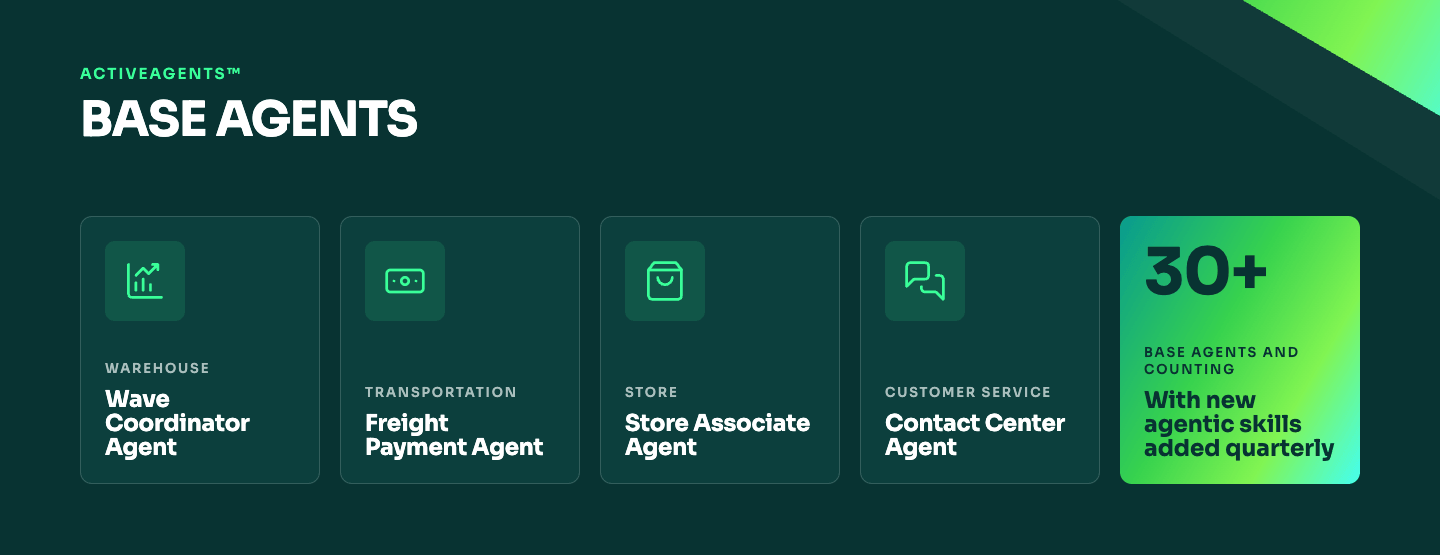
More than 30 pre-built base ActiveAgents are available across Manhattan Active solution areas, and new agents and skills are added every 90 days. They run inside Warehouse Management, Transportation Management, Order Management and Store Operations, so insights, recommendations and automated actions land where your teams already work.
|
Area |
Agents |
What they do |
|
Warehouse and labour |
Labour Agent |
Surfaces employee level performance, utilisation, status, gap time and tardiness insights so supervisors can rebalance work |
|
Warehouse execution |
Wave Coordinator Agent |
Researches wave issues such as short inventory, identifies impacted items and surfaces resolution paths |
|
Warehouse associate support |
Warehouse Associate Agent |
Delivers guidance, SOPs and FAQs inside the mobile workflow so associates complete work accurately |
|
Transportation |
Freight Payment Agent, Shipment Tracking Agent, Transportation Planner Agent |
Support invoice processing, shipment visibility and planning workflows with operational context |
|
Store and customer service |
Store Associate Agent, Contact Center Agent |
Surface sales, fulfilment, order, shipment, promotion and service insights so employees respond faster |
|
Order management |
Order Creation Agent, OMS Configuration Agent |
Help structure B2B orders and guide inventory promise configuration using natural language |
|
Platform and extensions |
Solution Navigator Agent, Configuration Manager Agent, Extension Manager Agent |
Help users find product knowledge, compare configuration and manage extension lifecycles |
Build Custom Supply Chain AI Agents with Agent Foundry
Manhattan’s Agent Foundry™ gives customers an environment to create, customise, test, version and deploy custom agents. Business users can describe a requirement in plain language, start with templates and use natural-language instructions. Developers can create agents from scratch, connect Manhattan Active APIs or other data sources and define multi-step workflows. Agent Foundry supports both no-code configuration and deeper technical control, including extensions created with Proactive™.
Agent Foundry supports an iterative approach: create, test, version and deploy agents as business needs change. Reusable templates and components can help teams extend their digital workforce without starting from scratch each time.
Measure ROI and Productivity Gains with Supply Chain AI Agents
Every AI initiative should answer a practical question: what changed in the operation? ActiveAgents support conversation with execution tracing and structured logging, plus before-and-after measurement of outcomes such as decision speed, exception-handling time, errors and productivity. Teams can use those baselines to see where an agent is helping and where its workflow needs refinement.
Manhattan projects agent use cases are expected to enable productivity gains of up to 60 percent over time. That figure is not a universal guarantee: actual results depend on the use case, baseline, workflow design, adoption, permissions and customer environment. The right way to evaluate value is to establish a baseline, measure the same process after deployment and report the outcome clearly.
Trustworthy AI Agents: Security, Guardrails and Performance
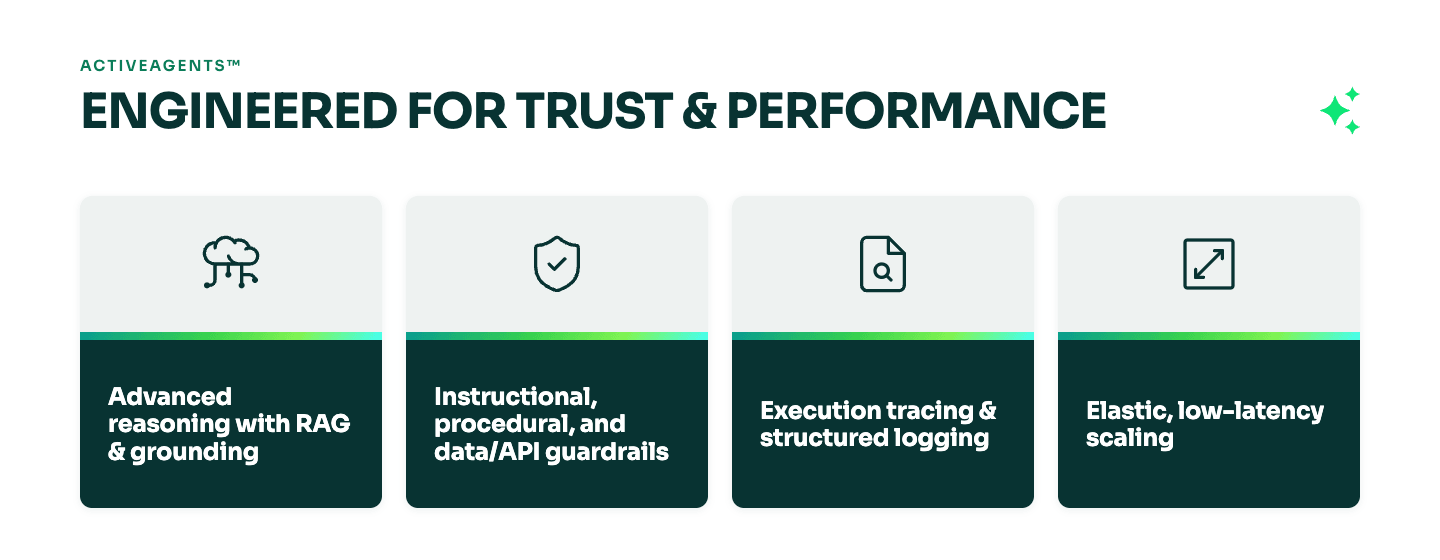
ActiveAgents use an advanced reasoning engine with retrieval-augmented generation (RAG) and grounding to connect responses to relevant enterprise data, including information from Manhattan Active solutions. This is designed to improve context and reduce unsupported answers; agent output remains probabilistic, so organisations should pair it with the appropriate review, approval and monitoring controls.
Trust is built into the agent lifecycle. Instructional, procedural and data/API guardrails help define what an agent can do, which workflows require approval and which systems or data it can access. Content sanitisation, execution tracing and structured logging help teams monitor activity, response times and resource consumption. Together, these controls support enterprise governance without suggesting that AI can operate outside human-defined policy.
A Future-Ready Agentic AI Strategy for Multi-Site Supply Chains
Agentic AI changes software from a tool that waits for every instruction into a system that can reason around goals, use tools, and coordinate work. ActiveAgents can collaborate with other agents through agent-to-agent (A2A) and model context protocol (MCP) integrations. There is additional availability through Google Agentspace giving customers a path to connect supply chain agents with a broader agent ecosystem.
Because ActiveAgents are built onto ActivePlatform, customers can extend their operational platform rather than introduce a separate AI layer. The applicable security, governance, audit and performance controls depend on the solution, agent and customer configuration; they should be validated as part of deployment.
ActiveAgents vs. Generic AI Chatbots for Commerce
Your competitive advantage lives in operations: inventory movement, order orchestration, workforce productivity and transportation coordination. ActiveAgents are designed to add goal-oriented reasoning, operational context, tool use and workflow execution to that conversation.
|
Capability |
Generic AI chatbot |
ActiveAgents |
|
Where it runs |
Beside the systems of record |
Inside Manhattan Active, with access to its operational data, business logic and tools |
|
What it produces |
Conversation and predefined responses |
Reasoning across multi step workflows, plus authorised action or a routed approval |
|
Proof of value |
Engagement metrics |
Execution tracing, structured logging, before and after baselines on decision speed, errors, exception handling and productivity |
|
Enterprise controls |
Varies by tool |
Guardrails, permissions, approvals, grounding, monitoring and auditability |
The bottom line: AI demos are impressive. But operational value must be proven. ActiveAgents bring Manhattan’s platform, supply chain expertise and governed execution model together so organisations can move from AI experimentation toward measurable work in live operations.
Ready to see how agentic AI works in supply chain operations? Visit the ActiveAgents page to explore capabilities, review available agents, and learn how Manhattan helps customers move from AI hype to operational value.
Frequently Asked Questions
Manhattan ActiveAgents are pre-built and customer-created AI agents for supply chain commerce. Built into Manhattan Active, they use operational context, tools and workflows to reason about goals, provide recommendations and, when configured and authorised, execute actions.
ActiveAgents work by analysing a request, using relevant Manhattan Active data and tools, planning one or more steps, and either completing an authorised action or presenting the next step for review. Their use cases can span warehouse, transportation, order, store, planning and platform operations.
Chatbots primarily support conversation and predefined responses, while ActiveAgents are goal-oriented applications that can use tools, manage multi-step workflows and support operational execution. The exact level of autonomy depends on the agent, workflow, permissions and customer configuration.
ActiveAgents use grounding and retrieval-augmented generation to connect responses to relevant enterprise data. Instructional, procedural and data/API guardrails, along with content sanitisation, execution tracing and structured logging, help teams govern and monitor agent work.
Yes. Agent Foundry lets customers create, customise, test, version and deploy custom agents. Business users can start with natural-language requirements and templates, while developers can create agents from scratch, connect APIs or other data sources and define multi-step workflows.
Ready to see how agentic AI works in real supply chain operations?
Visit the AI Agents Page to explore capabilities, watch customer stories, and discover how Manhattan Active Agents transform commerce execution.