Notes from Milan: humans are still the pilots, not the passengers
- 19 October 2026
- Manhattan Associates
- 2 minutes

Key Takeaways
- Manhattan’s 10th annual EMEA customer and partner gathering in Milan included speakers from brands including CEVA, Foot Locker, JD Sports, Moncler and L’Oréal
- CEO Eric Clark argued that “complexity in your software is a tax”, and Manhattan is cutting it with simpler editions and deployments up to 50% faster
- Manhattan regenerates around 75% of its 60m-line platform nightly, giving AI a “deterministic spine,” but act through fixed APIs within set guardrails
- Maven deflects over 65% of enquiries at some clients, while the winners will be organisations that let machines carry the load while people choose the destination
Milan has long been a place where ideas meet commerce. Leonardo da Vinci filled his notebooks here with machines far ahead of their time, and for a thousand years the Po valley has funnelled merchants, goods and ideas towards the markets of not just Italy, but Europe too.
It was a fitting setting for the 10th edition of Exchange, the annual gathering of Manhattan customers, partners and leaders and over two and a half days, executives from retail and supply chain came to compare notes, share stories and discuss the topics of the moment as part of a community with a clear sense of where its industry is heading.
Delegates came from companies such as CEVA, Foot Locker, L’Oréal, Bauhaus, JD Sports, Moncler and many other recognisable brands. Eric Clark, CEO Manhattan opened the show, highlighting the $3trn of commerce that Manhattan’s customers underpin globally. It was a generous way to start, and that generosity became a core theme throughout the show.
Naturally, AI was a popular topic, but it was discussed in a more measured and positive tone than the current narratives in Silicon Valley or the media.
Clark’s organising metaphor was the cockpit: an airliner once needed five crew and now needs two, not because flying got easier but because the instruments absorb complexity rather than merely displaying it. The pilot still decides, but the aircraft now carries its share of the load.
Warehouse planners, transportation and store managers are the pilots, and their software should act more like an autopilot. “Complexity in the market is an opportunity, but complexity in your software is a tax,” ran the line from Clark.
Manhattan has begun cutting that tax in every way. Its applications have been renamed for simplicity, it now comes in three editions, from Essentials to, Enterprise, to Enterprise Premier, so that growing firms can start modestly and grow without re-implementing.
Speed to value is improving too. Warehouse deployments are up to 50% quicker, stores and orders can go live in as little as 100 days, and transport in 14 weeks, 40% faster than a year ago.
Some of the boldest ideas came from CTO, Sanjeev Siotia who argued that bolting an AI model onto an old system, is this decade’s version of a “mobile wrapper”, a stopgap that will soon be forgotten.
Manhattan’s alternative is to generate its code rather than write it. Some 75% of the platform’s 60m lines are regenerated every night, which, he said, “leaves it with no technical debt and unlike an archaeological dig, no way of carbon-dating it.”
For context, he noted, the world’s most advanced fighter jet runs on approximately 8.5m lines of code. Humans specify the rules and machines produce the code, giving what he calls a “deterministic spine” into which the probabilistic brain of an AI model can be plugged.
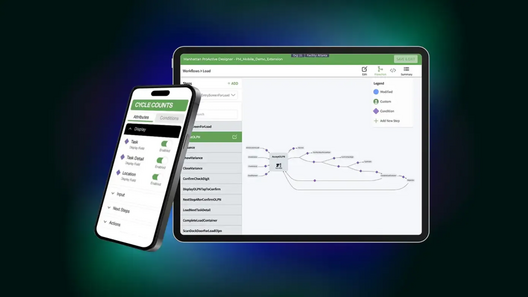
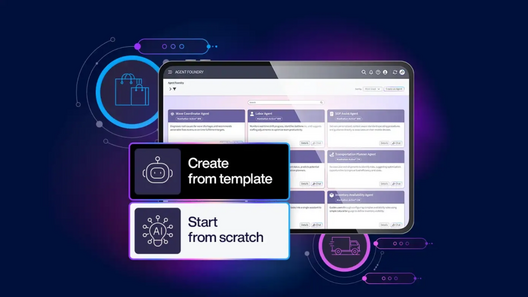
The logic is attractive. In warehouses, ‘almost correct’ is a polite word for wrong, so Manhattan’s agents think with a language model but act through fixed APIs, within set guardrails. A manager might decree that any department more than two hours behind plan should trigger a rebalancing of staff, and the system obliges. A new design tool reads a requirements document and configures the software.
Customers had plenty of stories and results of their own to share too. A pharmaceutical distributor reported double-digit reductions in loading times. SP Richards, a distributor, cut its weekly inventory transfers from 109 to 19.
A Canadian retailer, switched on point-of-sale software across more than 700 registers in eight days, while Maven, Manhattan’s customer-service agent, now deflects more than 65% of enquiries at some clients, and a global power-management company reported 34% more lines shipped per day.
Beyond the stories there was plenty of time to celebrate the outstanding customer projects of the last 12 months too. Kave, a Spanish furniture retailer, went from selecting its warehouse and transport software to a unified supply chain in eight months, and collected an award for it, alongside DHL, BAUHAUS and L’Oréal, whose Agentic AI pilot, followed by a highly successful deployment won it plaudits too.
Yet the most persuasive point was maybe the least technological.
Smarter machines, noted Sebastien Lefebure, the European chief, are easier than ever to build, but the aim is to build smarter organisations, and that’s the hard part. Katie Foote, the CMO (attending her first Exchange), singled out a candid panel in which Aldi, Co-op and Asda swapped notes, the sort of exchange, in the literal sense, that tends to become next year’s main stage talk.
Lefebure summed up the cut and thrust of the event as a “touch of humanity that AI can only imitate but never replace.”
And that is a message worth taking seriously. In a moment in time where it is easy to be overwhelmed by the pace of technological change and the sheer volume of information available, Exchange paired a sensible view of AI, as an accelerant that needs something worthy to accelerate, with a community that plainly enjoys one another’s company.
In an industry where ‘almost correct’ means wrong, the organisations that win will be the ones that let machines carry the load and keep people firmly in charge of where it goes – the aircraft may fly itself, but someone still has to choose the destination.