AI and Machine Learning in Supply Chain
How ML works across warehouse, order, store, and transportation — on one platform, at any stage of growth.
- October 6, 2026
- Manhattan Staff
- 7 minutes

Key Takeaways
- From reactive rules to adaptive execution: Artificial intelligence (AI) and machine learning (ML) have evolved beyond standalone forecasting tools into an embedded operational engine that optimizes decisions in real time across the physical supply chain.
- Unified intelligence beats point solutions: ML algorithms deliver measurable value only when they share a single data model with warehouse, order, store, and transportation execution. Disconnected models create local optimizations that break across handoffs.
- Autonomous agents are the new frontier: Modern supply chains are shifting from passive predictive dashboards to autonomous agents—such as Manhattan ActiveAgents™—that anticipate exceptions, orchestrate tasks, and act within governed boundaries.
- Available at your stage, not just at enterprise scale: Editions for Manhattan Active® solutions give growing commercial businesses a right-sized entry point (Essentials, Enterprise, and Enterprise Premier) with the exact same cloud-native foundation, AI capabilities, and quarterly innovation cadence used by global enterprises.
1.Moving Beyond Automation: The Role of the Machine Learning in Modern Supply Chains
In modern supply chain commerce, the ability to adapt to disruption is no longer a luxury; it is the baseline requirement for operational resilience. Achieving that resilience requires moving beyond static rules and manual workflows to embrace the transformative capabilities of artificial intelligence (AI) and machine learning (ML).
Where traditional supply chain software relies on historical averages and rigid, pre-configured parameters, machine learning algorithms continuously ingest live operational signals—from shifting consumer purchase patterns and supplier lead-time variances to warehouse labor bottlenecks and freight transit disruptions. Rather than merely automating repetitive administrative tasks, ML analyzes complex, non-linear relationships across millions of data points to predict outcomes, prescribe optimal actions, and execute micro-adjustments before operational delays manifest.
As customer expectations for speed and precision intensify alongside geopolitical volatility and cost pressures, AI and ML provide the technological foundation necessary to maintain continuous agility without sacrificing margin.

2. What Machine Learning Actually Does Across Supply Chains
1. Unified Demand Forecasting
Traditional forecasting methods struggle with sudden volatility, promotional spikes, and localized assortment shifts. Machine learning models incorporate multi-tier data sets—including historical point-of-sale patterns, macroeconomic indicators, weather forecasts, marketing calendars, and digital browsing behavior—to generate dynamic, hybrid demand forecasts. This granular visibility sharpens forecasting accuracy at the SKU, channel, and store level, curbing costly stockouts while minimizing obsolete safety stock.
2. Multi-Echelon Inventory Optimization
Inventory placement must balance customer proximity with carrying cost. AI algorithms continuously evaluate network-wide inventory positions against real-time demand signals and replenishment lead times. By anticipating shortages and identifying excess stock across distribution centers, regional hubs, and retail stores, ML models suggest dynamic rebalancing and optimal replenishment orders, keeping working capital focused where it drives revenue.
3. Intelligent Warehouse Orchestration
Within the distribution center, ML coordinates labor, robotics, and facility throughput in real time. Rather than releasing static batches of orders, intelligent warehouse execution systems dynamically prioritize tasks based on carrier cut-off times, machine availability, and inventory locations. ML optimizes wave-less order streaming, calculates travel-minimizing pick routes, balances workload between human staff and autonomous mobile robots (AMRs), and dynamically manages yard operations.
4. Dynamic Transportation & Freight Optimization
Transportation networks operate in constant flux. Machine learning models analyze real-time carrier performance, historical transit delays, weather patterns, and fuel fluctuations to optimize route planning, load consolidation, and mode selection. Predictive models alert logistics planners to probable transit delays hours or days before they occur, allowing teams to reroute shipments, reassign carriers, or adjust dock schedules automatically.
5. Labor Scheduling & Productivity Management
Labor availability and labor costs represent some of the largest variable expenses in supply chain execution. ML-powered labor management solutions evaluate historical productivity, individual skill matrices, order profile complexity, and ergonomic factors to forecast staffing needs accurately. The software generates fair, optimized schedules and dynamically recalculates engineered labor standards as warehouse operating conditions shift.
6. Predictive Maintenance & Asset Reliability
Material handling equipment breakdowns halt fulfillment lines and cause cascade delays. By monitoring IoT sensor telemetry—including vibration, motor temperature, power draw, and cycle counts—ML algorithms identify early signatures of mechanical wear. Maintenance teams receive automated work orders to service conveyors, sorters, and robotic arms during scheduled downtimes, avoiding catastrophic mid-shift disruptions.
3. The Critical Distinction: Why You Need a Platform, Not Disconnected ML Features
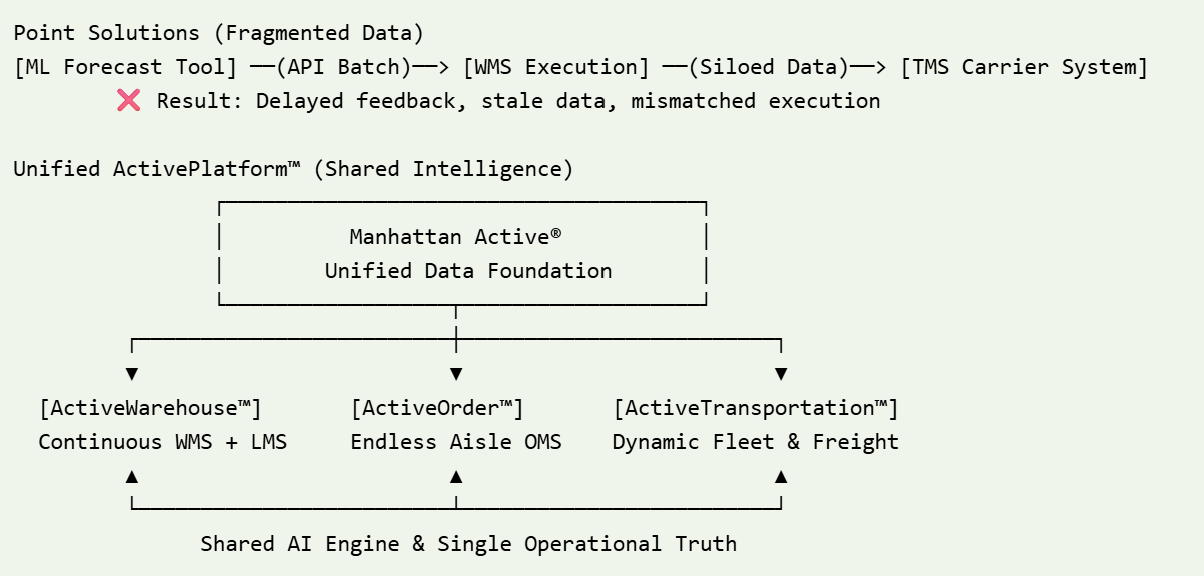
Many organizations attempt to capture the benefits of artificial intelligence by purchasing specialized point solutions: an AI forecasting tool here, an inventory optimizer there, and a standalone route planning application.
This fragmented approach almost always creates what industry leaders call the "local optimization trap."
When an ML model generates an optimized demand plan in a siloed planning system, but that plan cannot see real-time warehouse labor constraints or active carrier capacity, the forecast creates operational chaos rather than efficiency. A transportation algorithm that calculates the optimal freight load without knowing whether warehouse staff can pick and stage that load in time leads to missed appointments, detention fees, and broken delivery promises.
The Power of Manhattan ActivePlatform™
Real operational advantage requires unifying predictive models with physical execution on a single, cloud-native foundation.
This is the design principle behind Manhattan ActivePlatform™. Every Manhattan Active® solution—including ActiveWarehouse™, ActiveTransportation™, ActiveOrder™, and ActiveStore™—shares the same microservices architecture, the exact same underlying data model, and zero application seams:
- Execution Informs Intelligence: Every completed pick, packed pallet, store return, and delivered shipment updates the central data model instantaneously, feeding fresh ground-truth data back into learning algorithms.
- Intelligence Drives Execution: Algorithms do not merely output advisory reports for analysts to interpret; they dispatch optimized instructions directly to RF scanners, autonomous mobile robots, automated picking systems, and dispatch boards.
- No Synchronization Delays: Because planning and execution run on the same platform, decisions reflect the current state of the physical network, eliminating batch lag and integration brittle points.
4. From Predictive Insights to Autonomous Execution: The Rise of Agentic AI
Predictive analytics and prescriptive recommendations answered the questions "What will happen?" and "What should we do?"
The next frontier in supply chain technology is answering "Who will execute it?" This is the domain of Agentic AI.
In a traditional setup, when an exception occurs—such as a delayed container or an unexpected stock shortage—a supervisor must review an alert, navigate between screens to assess options, make a decision, and manually re-key instructions. In high-velocity environments, human review cannot scale with the speed of data.
- Descriptive (what happened?) > Historical reporting and dashboards
- Predictive (what will happen?) > ML demand forecasting and transit ETA models
- Prescriptive (what should we do?) > Algorithmic slotting and wave-less order rules
- Agentic AI (takes action safely) > Manhattan Active Agents resolve exceptions autonomously
Manhattan Agents & Agent Foundry
To solve this, Manhattan has introduced enterprise-grade autonomous capabilities designed specifically for supply chain commerce:
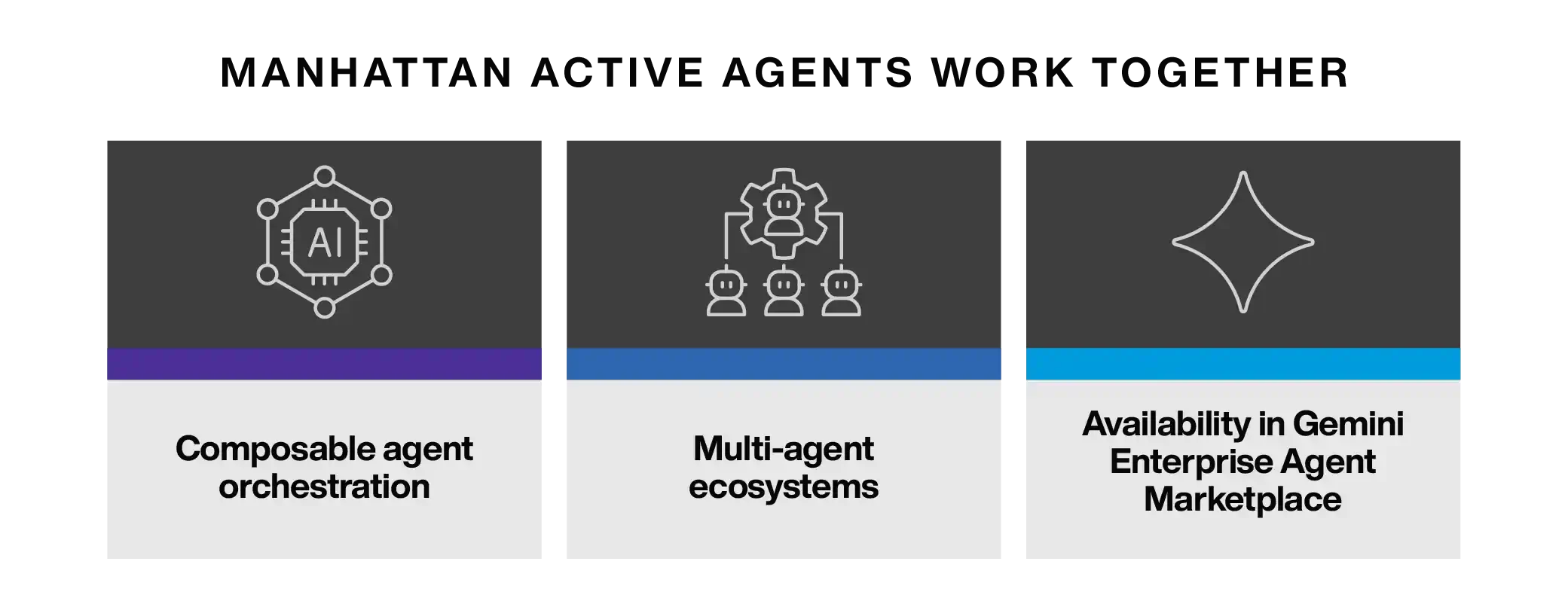
Manhattan ActiveAgents™: Purpose-built, autonomous software agents that reason, plan, collaborate, and act across complex business workflows. In customer care, an agent like Manhattan Active Maven can interpret intent, locate inventory across the enterprise, initiate an exchange, and issue return labels autonomously. In logistics, ActiveAgents monitor transit anomalies, negotiate alternate carrier capacity within preset guardrails, and adjust dock appointment windows without requiring manual supervisor intervention.
Manhattan Agent Foundry: A no-code and low-code agent creation environment that allows supply chain and IT leaders to design, test, customize, and govern autonomous agents. Business teams can define precise operational guardrails, configure API actions, and connect enterprise knowledge bases, ensuring agents execute tasks reliably within corporate policy.
By shifting routine exception handling to governed AI agents, supply chain organizations liberate experienced human talent to focus on strategic supplier negotiations, network expansion, and long-term customer relationships.
5. Where to Start: AI at Your Stage of Growth with Manhattan Editions
Historically, accessing unified, AI-native supply chain software required an enterprise-scale implementation scope that placed top-tier technology out of reach for growing commercial businesses. Organizations were forced to choose between lightweight software they would soon outgrow or heavyweight enterprise platforms with prohibitive complexity.
Editions for Manhattan Active® Solutions changes that paradigm.
Available across ActiveWarehouse™, ActiveOrder™, ActiveStore™, and ActiveTransportation™, Editions provide three right-sized access points designed to match your operational footprint today while preserving an uninterrupted path to expand tomorrow.
| ESSENTIALS | ENTERPRISE | ENTERPRISE PREMIER |
| Defined, focused, operational scope | Broader operational workflows and complexity | Deepest complexity, extensive scale and advanced custom configurations. |
| Learn More | Learn More | Learn More |
All powered by the EXACT same ActivePlatform, so you get:
- Same AI capabilities
- Same quarterly releases
- Zero replatforming
The Three Editions Framework
| Edition | Ideal Operational Profile | Core Focus |
| Essentials | Growing commercial businesses seeking to modernize a defined functional area (e.g., core DC fulfillment, unified store POS, or freight rating). | A focused, right-sized scope that deploys rapidly, delivering immediate operational lift without unnecessary overhead. |
| Enterprise | Organizations managing multi-channel workflows, expanding network nodes, and cross-functional coordination. | Comprehensive feature sets built for operational sophistication, coordinating inventory, labor, and transport across regions. |
| Enterprise Premier | High-volume global enterprises operating highly automated facilities with specialized configuration needs. | Complete breadth, depth, and extensibility designed for the highest scale, intricate robotics orchestration, and global logistics. |
The AI Advantage of Editions: Zero Compromise, Zero Replatforming
For organizations evaluating artificial intelligence, Editions introduces two decisive advantages:
- Uncompromised Intelligence Across All Tiers: Editions are not stripped-down or "lite" products. Whichever Edition you select, your software runs on the identical ActivePlatform™ foundation, with access to the same core machine learning capabilities and continuous quarterly innovation cadence that power the world's most sophisticated supply chains.
- Expansion Without System Replacement: When your business adds new distribution centers, expands into international channels, or introduces automated fulfillment options, you do not replace your system or migrate your data. You simply transition between Editions on the same platform. Your machine learning models retain historical training data, operational baselines, and institutional learning, continuing to deliver accurate predictions without interruption.
6. How to Evaluate an AI and ML Supply Chain Platform: A Buyer's Checklist
As artificial intelligence claims proliferate across enterprise software, evaluating vendor capabilities requires looking past marketing terminology to assess architectural reality. Use this practical framework when evaluating AI/ML supply chain software:
| Your Evaluation Criteria | Questions every buyer should ask a vendor |
| Architectural unity | Does the AI operate directly on live execution data, or does it require third-party ETL data synchronization into a data lake? |
| Continuous learning & updates | Is the software versionless and continuously updated, or will upgrading algorithms require a multi-year IT migration? |
| Execution Integration | Can the ML engine dispatch automated tasks directly into DC and freight workflows, or does it only present advisory dashboards? |
| Governed agentic capabilities | Does the platform offer autonomous agents with configurable guardrails, or is AI limited to basic pattern regression? |
| Scalability | Can our organization begin with a focused scope and expand on the exact same platform as order volume and complexity double? |
7. Getting Started. How to Build an AI-Native Supply Chain Foundation
The question for forward-looking operational leaders is no longer whether artificial intelligence and machine learning belong in the supply chain. The question is how quickly your organization can transition from fragmented, reactive decision-making to unified, predictive execution.
Begin by evaluating where unexpected disruptions and manual coordination cost your organization the most margin—whether in inventory forecasting inaccuracies, warehouse fulfillment bottlenecks, or unmanaged freight exceptions. Ensure whatever technology you implement offers a practical place to start today and room to grow as your commercial ambitions expand.
Explore Next Steps
- Discover your fit: Explore Editions for Manhattan Active Solutions to see how Essentials, Enterprise, and Enterprise Premier match your operating profile.
- See the platform in action: Visit the Product Tour Hub or watch our Demo Series.
- Connect with a specialist: Request a personalized demonstration to discuss your supply chain optimization roadmap.
8. Frequently Asked Questions
Machine learning in supply chain management refers to the application of self-refining mathematical algorithms that analyze historical and live operational data to identify patterns, forecast future conditions, and optimize business decisions. Unlike static software that relies on rigid business rules, ML continuously improves its predictive accuracy over time across demand planning, inventory placement, warehouse labor scheduling, and freight routing.
An AI feature is an isolated tool designed to solve a single problem in a silo, such as generating an algorithmic demand forecast in an Excel add-on or standalone tool. An AI supply chain platform unifies predictive models directly with physical execution systems (such as WMS, TMS, and OMS) on a single data model. On a unified platform like Manhattan ActivePlatform™, insights generated by algorithms automatically trigger coordinated execution across warehouse floors, store networks, and transportation fleets.
Yes. With the launch of Editions for Manhattan Active® solutions, commercial organizations can adopt enterprise-class supply chain technology through the Essentials edition. Essentials provides a focused scope tailored to current operational requirements, giving growing businesses access to proven cloud-native architecture and advanced AI capabilities without the cost or complexity of an expansive enterprise footprint.
Because Essentials, Enterprise, and Enterprise Premier are built on the identical ActivePlatform™ architecture, upgrading between editions requires no data migration or replatforming. As an organization adds fulfillment facilities, channels, or robotics automation, it unlocks additional system depth while preserving all historical model training data and operational logic.
While standard chatbots summarize text or answer basic inquiries, Manhattan ActiveAgents™ are autonomous, task-oriented software agents engineered specifically for supply chain commerce. Built with deep domain logic and governed by configurable enterprise guardrails, ActiveAgents can evaluate complex operational exceptions, formulate multi-step plans, interact with enterprise APIs, and take definitive operational actions, such as reallocating orders or adjusting carrier bookings without manual intervention.