Building for Growth or Buying to Outgrow?
Supply chain companies need a way to start with the capabilities they can use now and expand without replacing the foundation as their business grows.
- November 3, 2026
- Manhattan Associates
- Read Time: 3 Minutes
Choosing a supply chain and commerce software presents an uncomfortable tradeoff for a growing company: buy a system sized for today and risk hitting its limits or take on a broader enterprise platform that requires more people, time, or budget than the organization can commit.
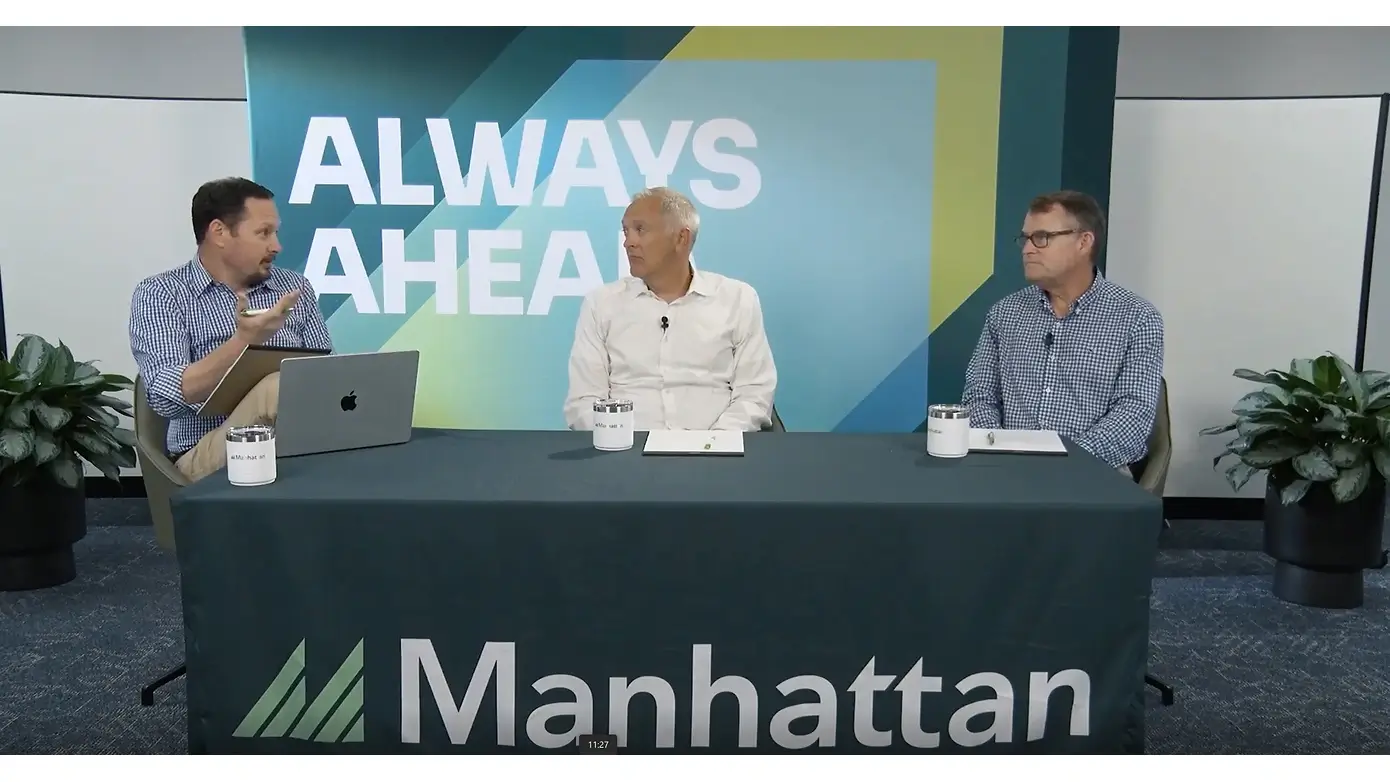
In a LinkedIn Live discussion titled Rethinking the Growth Path for Supply Chain and Commerce Technology, moderated by Chris Shaw, Manhattan’s VP of Product Marketing, Chris Gaffney, Director at Georgia Tech Supply Chain & Logistics, and Brian Kinsella, Chief Product Officer at Manhattan, the panelists described how there’s a third, phased option to technology adoption. Companies can start with software that supports their current workflows, then add capacity and capabilities as business needs change.
Business Growth Exposes Supply Chain Technology Gaps
Gaffney saw the technology gap between large and small bottlers firsthand in Coca-Cola’s U.S. franchise bottling system. He described a network with roughly 15 large bottlers operating more like enterprises and about 50 smaller, often family-owned businesses. They all used different technology stacks, yet some served the same major retailers, and had to address the same expectations from those customers.
That difference in scale can shape what software an organization can take on. Smaller companies “tend to underbuy because they feel like they’ve got to constrain resources,” said Gaffney. However, in doing so, they can end up choosing systems that only meet immediate needs and limits what they can do as the business expands.
The service requirements don’t shrink with company size. Gaffney noted that smaller businesses, including third-party logistics providers, participate in larger supply chains where customers expect to know where goods are and when they will arrive. Without technology that provides visibility, a business may have to compensate with additional manual effort, increasing labor costs, and overhead.
How Phased Software Implementation Gets Teams Value Sooner
Kinsella said software buyers are increasingly focused on speed: they want to realize the value of a software investment sooner and are more willing to implement in phases. To do that, instead of treating implementation as an all-at-once deployment of a large suite, companies should focus on their core set of best-practice workflows and expand software capabilities from there “based on what they’re seeing from their customers and other external forces in the market.”
Editions for Manhattan Active® solutions are designed around that approach, Kinsella said. A customer can start with a right-sized set of capabilities and, as needs grow, add users, transaction volume, or functionality without moving to a different platform or starting a new implementation. He described Editions as sharing the same technical platform, with additional capabilities activated when the customer is ready.
That distinction matters for companies that need more than a basic system but can’t justify adopting every advanced feature on day one. It also creates a route to new capabilities, including AI, without requiring a separate platform migration first.
Why Small Businesses Face the Same Customer Expectations as Larger Ones
Gaffney’s bottler example shows that, no matter how small a company is, its customers still expect the same reliable service and clear visibility they get from larger businesses, even when they don’t have as many technical resources.
Kinsella connected the same expectation to online shopping, where customers often judge a company by the whole order experience, and not just how one part, say, easy checkout is. He shared a personal example of an online purchase with a smooth checkout but slow fulfillment. “As consumers, we don’t really change our expectations based on the size of the company we think we’re dealing with,” he said. “The best experiences consumers encounter set the bar for everyone.”
For supply chain businesses, meeting that bar depends on accurate inventory, orders that move on time, and teams that can keep delivery promises.
How to Scale Supply Chain Software
Large, one-time transformations can be costly and disruptive. Gaffney said that, in his experience, fewer than half of large transformations succeed as originally designed. For businesses with limited IT capacity, the risk of a major change can make it even harder to adopt technology that supports future growth.
Kinsella argued for a more continuous software model where teams can adapt the system as the business changes, activate features already available, and add modules or capabilities when they provide value. Rather than waiting years for another major replacement, teams can make smaller decisions over time, or as Kinsella put it, “you don’t reach that cliff and then have to start all over again with a project.”
Growth shouldn’t force a company to choose between buying too little and outgrowing its systems, or buying too much and taking on unnecessary complexity. The better question is whether a company can begin with what it needs today, and keep building on that foundation as its customers, operations, and ambitions grow.
You can also watch the complete LinkedIn Live discussion on our YouTube channel.
For a closer look at how Editions give growing businesses a focused start with room to expand, read A Supply Chain Platform You Can Grow Into, Not Out Of.