Multiple Agents Create New Coordination Silos
Key Takeaways
- Agent-to-Agent (A2A) Protocol Eliminates AI Coordination Silos in Supply Chains
As organizations deploy more AI agents across demand planning, inventory management, warehouse operations, and transportation, coordination becomes the biggest challenge. A2A protocol provides a standardized communication framework that enables AI agents to automatically share data, request actions, and confirm outcomes without complex custom integrations, creating a truly connected multi-agent supply chain ecosystem. - Multi-Agent AI Networks Accelerate Supply Chain Decision-Making by Up to 60%
By enabling real-time collaboration between specialized AI agents, A2A protocol transforms supply chain execution from hours of manual coordination into minutes of autonomous action. In the example highlighted, four AI agents coordinated inventory, labor, transportation, and fulfillment decisions in just eight minutes—1.5 days faster than traditional manual processes—helping businesses improve responsiveness, reduce stockouts, and increase operational agility. - No-Code AI Agent Development Makes Enterprise-Scale Automation Accessible
Modern platforms like Manhattan ActivePlatform™ Agent Foundry simplify AI agent creation through visual workflows, prebuilt templates, and automatic A2A compliance. Supply chain teams can rapidly build, deploy, and scale interoperable AI agents without coding or integration work, accelerating digital transformation while reducing IT complexity and maintenance costs.
How many AI agents run in your supply chain right now? Most companies deploy several: a demand agent predicting regional spikes, an inventory agent optimizing stock across distribution centers, a warehouse agent coordinating labor and picking schedules, Each agent automates decisions in its specific area. Each delivers measurable value.
But these agents operate in isolation. When your demand agent forecasts a surge, your inventory agent doesn't automatically adjust allocation. When your warehouse agent frees up capacity, your fulfillment agent doesn't reroute orders there. Someone reviews the output from one agent, interprets what it means, then manually updates another system. The agents work fast. The coordination between them doesn't.
Building the agent takes 10% of the effort. Running a coordinated multi-agent network reliably in production takes the other 90%. Agent-to-Agent (A2A) protocol solves this coordination gap. It establishes communication standards that let agents share insights, request actions, and confirm results across system boundaries without custom integration work.
This article explains what A2A protocol is, how its five core elements enable multi-agent coordination through standardized communication. You’ll learn how Manhattan ActivePlatform™ Agent Foundry empowers supply chain experts to build A2A-compliant agents using visual workflows with no code or integration work required.
Why Coordination Lagged Behind Capability
Any developer can prompt an LLM to create a forecasting agent in an afternoon. The barrier to creating individual agents collapsed. The barrier to coordinating them stayed high.
Multi-agent coordination technology lagged agent creation by years. Vendors built agents using proprietary formats for describing capabilities, sharing data, and requesting actions. As a result, a Manhattan ActiveAgents™ couldn't coordinate with a Salesforce sales or a Mercury Gate logistics agent, they spoke different languages.
Integration became the bottleneck. Two agents need one connection. Five agents need ten. Ten agents need 45 custom integrations. IT teams face exponentially growing backlogs. You deployed AI to eliminate manual handoffs. Without agent-to-agent communication standards, you just moved those handoffs from process execution to agent coordination.
To see why this coordination overhead grows so quickly, look at what multi-agent systems handle in production.
What Are Multi-Agent Systems Used For?
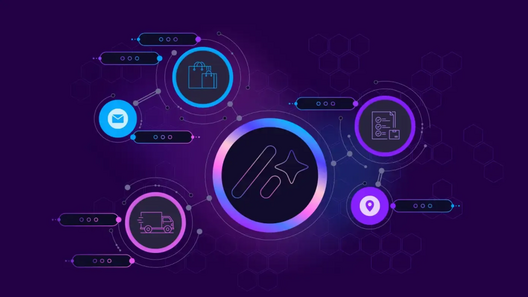
Multi-agent systems deploy specialized agents across different functions where complexity demands focused expertise. Companies use these systems to solve problems no single agent handles well: coordinating demand forecasting with inventory allocation, synchronizing warehouse operations with transportation schedules, and aligning fulfillment with capacity.
Real deployments include the Agent that reassigns warehouse workers based on real-time demand, the Wave Coordinator Agent that investigates shortages before they delay shipments, and planning agents that coordinate inventory across networks. These multi-agent AI systems deliver precision that generalist systems can’t match because each agent focuses on one domain.
Companies start where ROI shows up fastest. An inventory agent reducing carrying costs by 5% pays for itself within months. A demand agent preventing stockouts captures revenue that would otherwise disappear. The challenge emerges when agents need to work together. That's when multi-agent orchestration requires a common coordination language, what the industry calls Agent-to-Agent (A2A) protocol.
To understand how A2A protocol solves this challenge, start with what it is.
What is the A2A Protocol?
A2A protocol defines the communication standard that AI agents use to identify themselves, exchange data, request actions, and confirm results using a common format every compliant agent recognizes automatically. Think of email protocols: Gmail and Outlook communicate seamlessly because both follow shared standards. Your Manhattan Wave Coordinator broadcasts a fulfillment priority update using A2A protocol. Salesforce agents, carrier management agents, and Manhattan's Contact Center Agent all receive it. They speak the same coordination language. No custom middleware. No integration project.
Now that you understand what A2A protocol is, see how agents actually use it to coordinate actions.
How AI Agents Use the A2A Protocol
AI agents use the A2A protocol through five standardized elements that specify how they exchange information, coordinate actions, and confirm results. Each element ensures agents from different vendors work together in multi-agent AI systems without custom integration.
The Five Core Elements of A2A Protocol
- Agent Identity and Discovery
Through A2A protocol, each agent announces what it does, its domain, and what insights it produces. When you deploy a demand agent, it broadcasts capabilities using A2A protocol formatting so other agents discover this partner without manual configuration. - Capability Sharing
Agents use A2A protocol to publish actions they perform, inputs they require, and outputs they produce. This creates a catalog that orchestration layers reference when building multi-agent workflows. - Standardized Data Exchange
A2A protocol defines consistent schemas for information exchange. Demand forecasts, inventory positions, capacity constraints, and delivery commitments all follow A2A protocol structure. This eliminates interpretation errors in agent-to-agent communication. - Action Requests
Agents use A2A protocol syntax to ask others to perform tasks. A demand agent sends a properly formatted A2A protocol request with context. The receiving agent parses the A2A protocol message and knows exactly what to do. - Confirmation and Error Handling
Through A2A protocol, agents acknowledge completion, report progress, and surface issues in consistent formats. This creates feedback loops verifying multi-agent coordination worked and escalating intelligently when it doesn't.
A2A protocol standards define the communication layer. But platforms must implement these standards reliably for production deployment. Now visualize these five elements working together in a real supply chain scenario.
Eight Minutes Versus Eight Hours
A retailer launches a flash promotion. What follows shows the difference A2A protocol makes when agents coordinate on a unified platform.
Agents pull live data directly from operational systems through APIs, not stale snapshots stored in data lakes. When the Wave Coordinator Agent broadcasts a forecast through A2A protocol, every connected agent receives it within milliseconds.
How Four Agents Coordinate in Minutes
Step 1: Wave Coordinator Agent (9:03 AM)
Detects an order spike for a high-velocity SKU and predicts a 35 percent volume increase over 72 hours. Flags the demand against current inventory positions across six distribution centers. Identifies that Atlanta DC needs 2,000 units from Dallas DC. Broadcasts the transfer request through A2A protocol with priority, deadline, and full operational context.
Step 2: Labor Agent (9:04 AM)
Receives the reallocation request through A2A protocol and checks zone-level capacity across both distribution centers. Identifies Zone 3 at Atlanta DC as over-capacity for the incoming volume. Reallocates associates to Zone 1, which has the labor and space to absorb the transfer. Confirms readiness and updates the Wave Coordinator Agent through agent-to-agent communication.
Step 3: Transportation Planner Agent (9:05 AM)
Receives the updated transfer plan and reviews available carrier capacity on the Dallas-Atlanta lane. Identifies a consolidation opportunity on two outbound lanes and adjusts the load plan. Schedules picking, packing, and shipment with a 36-hour estimated arrival. Confirms feasibility before the first pick ticket prints.
Step 4: Shipment Tracking Agent (9:15 AM)
Monitors the transfer in real time from departure through delivery at Atlanta DC. Detects a potential delay on the Dallas-Atlanta lane and triggers replanning before the estimated arrival slips. Sends the Wave Coordinator Agent an updated arrival window with revised inventory availability. Atlanta DC receives confirmed stock with no service commitment broken.
Result: Eight minutes from signal to coordinated response. Zero manual interventions. Four AI agents coordinating across inventory, labor, transportation, and fulfillment on the ActivePlatform foundation. The autonomous response completes 1.5 days faster than a manual process.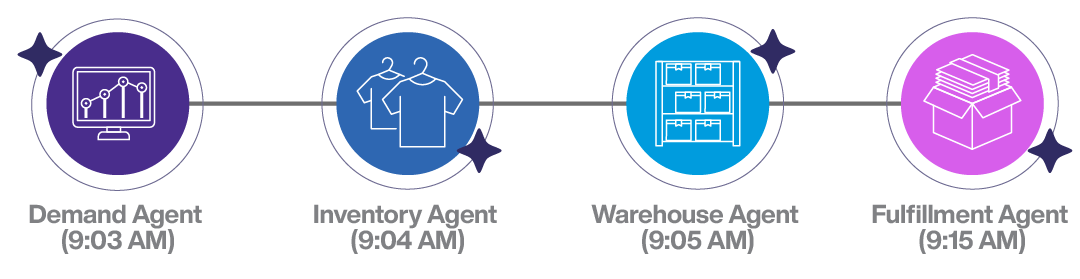
Without A2A protocol: The same prediction fires at 9:03 AM. A planner validates it by 11 AM, adjusts release rules, and emails the warehouse at noon. The transfer confirms at 2 PM. Stock moves at 4 PM. Orders placed at 9:15 AM face stockouts.
Eight hours versus eight minutes. The difference: human handoffs.
Enterprises report 30% to 60% improvements in decision-making speed through supply chain AI automation.
That eight-minute coordination workflow raises a natural question: what enables four different agents to orchestrate actions across demand, inventory, warehouse, and fulfillment without anyone building custom integrations between them? Answer, the A2A protocol.
How to Build Agents with A2A Protocol Built In
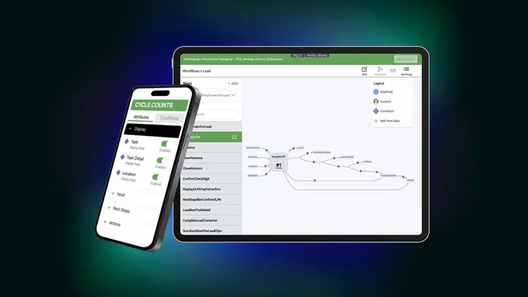
Supply chain practitioners build custom AI agents for any supply chain commerce process using Manhattan Agent Foundry, a visual, no-code environment designed for speed and simplicity. A2A protocol compliance builds in automatically as you work. No integration work needed. The platform handles all agent-to-agent communication in the background. You focus on defining what your agent does. The platform ensures it speaks A2A.
The process follows four steps, each handled through visual selections, not code.
Step 1: Define Agent Triggers
Select the operational conditions that wake up your agent and tell it to act. Choose from events the platform already monitors:
- A demand forecast crosses a confidence threshold
- Inventory drops below safety stock levels
- A carrier reports a delivery delay
- An order arrives outside normal patterns
Select triggers from a menu. The platform wraps them in A2A protocol formatting automatically. No custom event handlers needed.
Step 2: Select Data Sources
Define what information your agent needs to make decisions. Select from available data sources:
- Current inventory levels across all locations
- Open purchase orders and lead times
- Demand forecasts with confidence scores
- Warehouse capacity and labor availability
The platform creates API connections automatically and structures data exchange using A2A protocol standards. No API calls to write. No schema mapping required.
Step 3: Configure Decision Logic
Define the rules your agent follows using simple if-then statements:
- If inventory falls below 1,000 units AND demand forecasting shows a 20% increase AND lead time exceeds five days, THEN trigger replenishment
- If warehouse capacity drops below 30% AND new orders arrive, THEN alert the fulfillment agent
The platform translates your business logic into deterministic rules that run identically every time. Same inputs, same output, every time.
Step 4: Specify Agent Actions
Define what your agent does when conditions match:
- Place replenishment orders automatically
- Reallocate stock between distribution centers
- Adjust labor schedules to match workload changes
- Reroute shipments to alternate locations
Agent Foundry handles A2A protocol messaging automatically, ensuring your agent joins the interoperable agent network immediately.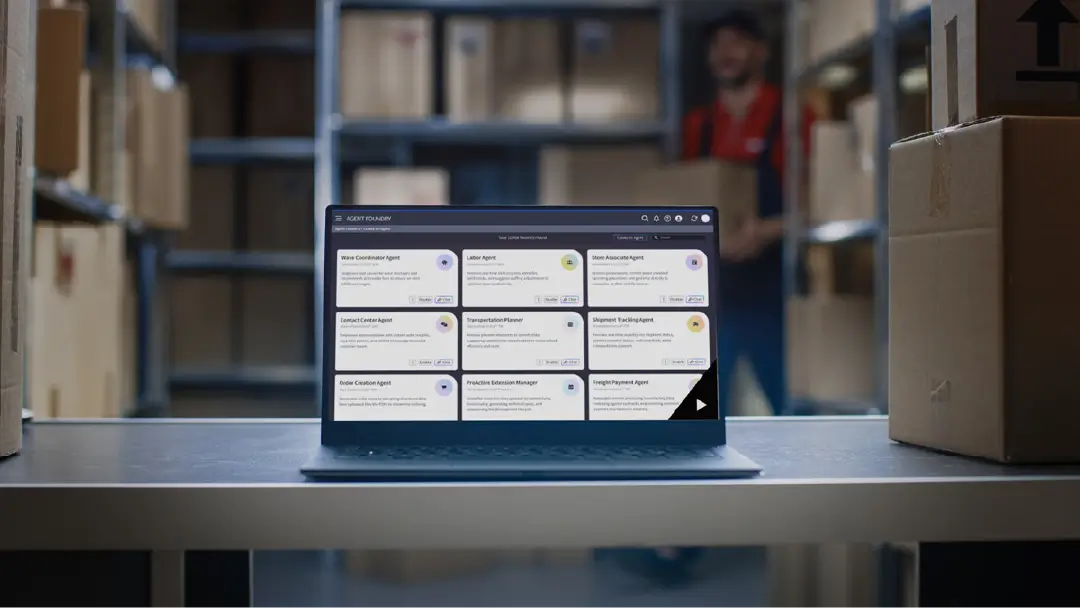
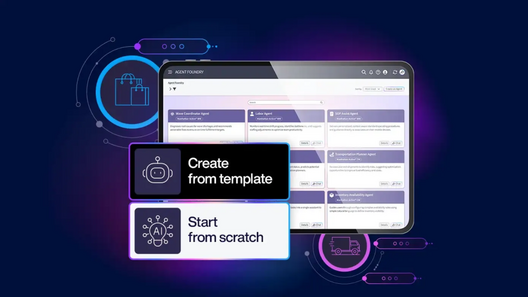
Use Templates or Build From Scratch
Agent Foundry, the same platform Manhattan's teams use to build the Labor Optimizer Agent and Wave Inventory Research Agent, comes included with every Manhattan ActivePlatform™ solution. Business practitioners start from an existing agent template, describe the changes they need in plain English, and let helper agents handle the build. Developers build from scratch with fine-grained control over reasoning logic, workflows, and API connections.
Start with pre-built templates for common workflows. A "demand spike response" template includes trigger logic, data connections, decision rules, and A2A protocol coordination messages already configured. Customize thresholds for your business. Adjust actions to match your policies. Deploy an agent that speaks A2A protocol from day one, no custom code required.
Or build from a blank canvas when your workflow doesn't match existing patterns. The platform ensures every agent communicates through A2A protocol standards automatically.
The platform also handles 156 million daily API calls and delivers new capabilities every 90 days. When A2A protocol standards evolve, Agent Foundry updates every deployed agent automatically. The service layer handles security, governance, liability, and standards maintenance, making agent networks enterprise-ready, not just pilot-ready.
From Manual Coordination to Automated Intelligence
Supply chain planners spent hours bridging agent systems manually. They reviewed forecasts, then logged into inventory systems to adjust rules. They checked capacity, then updated commitments. The coordination consumed time that should focus on supply chain planning strategy.
IT teams faced impossible backlogs. Each new agent required custom integration with every existing agent. The integration work grew exponentially.
Now roles shift to strategic multi-agent orchestration. Early adopters report 30% to 60% improvements in decision-making speed, freeing planners from overhead. Planners define priorities when agents conflict. They set thresholds. They review outcomes. The manual work disappears. The strategic work intensifies.
Companies investing in A2A-ready platforms build working interoperable agent networks now. By the time consensus forms, early adopters have refined autonomous supply chain workflows through production experience.
The shift from isolated agents to coordinated intelligence requires both standards and platforms working together.
Stop Building Custom Integrations Between Every Agent
Most companies hit the same wall: they deploy three agents, then realize coordination requires 45 integrations at ten agents. IT backlogs grow. Planners spend hours manually moving insights between systems. The agents work fast. The coordination doesn't.
A2A protocol eliminates this problem. Agent Foundry builds A2A compliance into every agent automatically, whether you start from templates or build from scratch. ActivePlatform™ handles agent-to-agent communication, standards updates, and multi-agent orchestration without custom integration code. New agents join the network and coordinate immediately.
Learn more about Agent Foundry and A2A protocol implementation.
Frequently Asked Questions
A2A protocol is the communication standard that defines how AI agents coordinate by identifying themselves, sharing data, requesting actions, and confirming results using formats every compliant agent understands automatically.
AI agents communicate through five standardized elements: identity and discovery, capability sharing, standardized data exchange, action requests, and confirmation handling—all defined by A2A protocol.
Multi-agent systems deploy specialized agents across demand forecasting, inventory optimization, warehouse coordination, and order routing—solving problems no single agent handles well by coordinating actions automatically.
Agent Foundry's visual workflow builder lets supply chain experts design agents without programming. A2A protocol compliance builds in automatically—no code required, no integration work needed.