
Autonomous Agents Transform Operations From Reactive to Proactive
How much time do your planners waste on daily decisions instead of strategic work? Supply chains now generate hundreds of decisions per day, which products to reorder, how much inventory each location needs, when to move stock between buildings, which shipments get priority when capacity tightens.
Agentic AI and agentic workflows, powered with AI agents, provide the solution: autonomous systems that detect problems, choose solutions, and act with minimal human input.
This guide explains how they transform operations from reactive tactics to proactive strategy.
What is Agentic AI?
Agentic AI delivers outcomes by letting autonomous agents pursue defined objectives through a think-see-do loop: assessing situations, making decisions, and acting without hardcoded logic for every scenario.
What are Agentic Workflows?
Agentic workflows put agentic AI into action as systematic processes that empower AI agents to think, see, and do using rich data and business logic via platform APIs for unprecedented supply chain automation.
What is an AI Agent?
An AI agent is specialized software powered by large language models (LLMs), AI systems trained on vast text data to understand and generate human-like language. These agents autonomously perceive situations, make decisions, and take actions using available tools. They adapt in real-time, unlike rigid, rule-based software.
Key difference: Unlike traditional software following fixed rules, agents make decisions and take actions while adapting in real-time to achieve assigned goals.
Manhattan has launched comprehensive Agentic AI support including intelligent, autonomous digital agents to revolutionize supply chain commerce execution, optimization, and user experiences. These out-of-the-box AI agents, powered by LLMs and Manhattan's cloud-native, all-microservice API architecture, autonomously perform tasks, adapt to changing conditions, and dynamically orchestrate workflows.
This type of agentic AI support marks a generational leap from traditional chatbots and static workflow configurations to dynamic, intelligent, and situationally aware orchestration across the entire supply chain and commerce lifecycle.
Traditional AI vs. Agentic AI: What's the Difference?
|
Traditional AI |
Agentic AI Systems |
|
Forecasts demand |
Forecasts demand and adjusts reorder points automatically |
|
Flags low-stock alert |
Detects low stock and creates transfer order |
|
Recommends markdowns |
Simulates scenarios and surfaces best option |
|
Identifies late shipment |
Flags delay and reroutes inventory |

The difference: Traditional AI predicts. Agentic ai in supply chain predicts and executes.
Key Takeaway: Agentic AI closes the loop from detection to action without manual handoffs required.
But what's driving this shift from prediction to execution? Let's look at the forces converging to make autonomous decisions not just possible, but necessary.
Why Supply Chains Need Agentic AI Now?
Four forces push supply chains toward autonomous decision systems:
Volume Overload
- Volatile demand patterns create more decisions than teams can handle
- Omnichannel complexity (managing inventory across stores, online, direct-to-customer) multiplies decision points
- Manual review becomes the bottleneck
Speed Requirements
- Supply chains that once planned weekly now adjust hourly
- Overnight batch jobs arrive too late when conditions change by the minute
- Decision velocity determines competitive advantage
Complexity Growth
- Navigates multiple variables—inventory, suppliers, transportation, labor, service commitments, costs
- Weighing trade-offs manually slows response time
- Interconnected decisions require coordinated actions
Talent Scarcity
- Labor shortages reduce available expertise
- Experienced planners retire faster than replacements develop intuition
- Knowledge gaps widen while decision complexity grows
The breaking point: The traditional model, humans reviewing AI recommendations and manually executing approved actions, can't keep pace.
"In today's dynamic market, cloud-driven flexibility isn't just an advantage—it's essential for business success. Manhattan's deep expertise in supply chain technology coupled with Google Cloud's powerful, scalable infrastructure is perfectly placed to deliver AI-driven solutions."
Eric Clark, President & CEO, Manhattan Associates
Understanding the "why" sets the stage. Now let's explore the mechanics of “how” agentic workflows operate.
How Agentic Workflows Operate?
AI agents flourish with the Manhattan Active Platform. Using rich data and business logic accessed through the platform's APIs, AI agents can think, see, and do with remarkable efficiency, paving the way for unprecedented automation in supply chain commerce.
- See: Agents access real-time data across inventory, orders, capacity, labor, and transportation through platform APIs.
- Think: Agents evaluate options against policies and constraints, balancing multiple objectives simultaneously—this represents ai orchestration.
- Do: Agents execute low-risk decisions automatically within defined guardrails, surfacing high-stakes moves for human approval.
This continuous loop enables supply chains to respond in minutes instead of days.
Now that you understand how workflows operate, let's see what this looks like in practice across actual supply chain operations.
Real-World Applications
Warehouse Operations
Labor Optimization
- Tracks work across zones in real-time
- Identifies bottlenecks, suggests resource adjustments
- Initiates labor moves automatically
- Result: Supervisor focus shifts from data analysis to coaching
Order Release
- Monitors picking queues (lists of orders waiting fulfillment)
- Tracks labor availability, dock congestion (too many trucks waiting), shipping deadlines
- Releases orders in smart batches
- Steers work to zones with capacity
- Result: Maximized throughput, reduced congestion
Wave Management
- Provides SKU-level insights when inventory shortages delay picking
- Identifies available inventory for deselected items
- Recommends alternatives
- Result: Reduced lead times, improved fill rates
Transportation Operations
Shipment Monitoring
- Monitors across all modes and carriers
- Predicts delays using traffic and weather data
- Auto-cancels/rebooks appointments or triggers replanning
- Result: Improved on-time delivery, automated issue resolution
Freight Settlement
- Processes carrier invoices automatically through OCR (optical character recognition)
- Manages unstructured data from emails and PDFs
- Supports multiple currencies and languages
- Result: Reduced manual entry, fewer errors
Load Optimization
- Reviews shipments before departure
- Identifies constraint violations, missed consolidation opportunities
- Learns from past decisions
- Result: Increased trailer utilization, reduced empty miles
Planning Operations
Inventory Rebalancing
- Monitors demand signals, seasonal patterns, multi-echelon relationships (how inventory at different locations affects each other)
- Detects imbalances—one location overstocked, another running low
- Creates transfer orders, adjusts reorder points automatically
- Result: Network self-balances in minutes, not days
Demand Response
- Evaluates options when spikes occur reallocate stock, place emergency orders, adjust safety stock levels (buffer inventory preventing stockouts)
- Executes low risk moves autonomously
- Surfaces high-impact decisions for planner approval
- Result: Faster response to market changes
These applications demonstrate what agentic AI accomplishes across your supply chain. Manhattan Agent Foundry provides the tools to build custom agents tailored to your unique operations.
Manhattan's Agentic AI Solutions
Manhattan Agent Foundry: Build Your AI Workforce
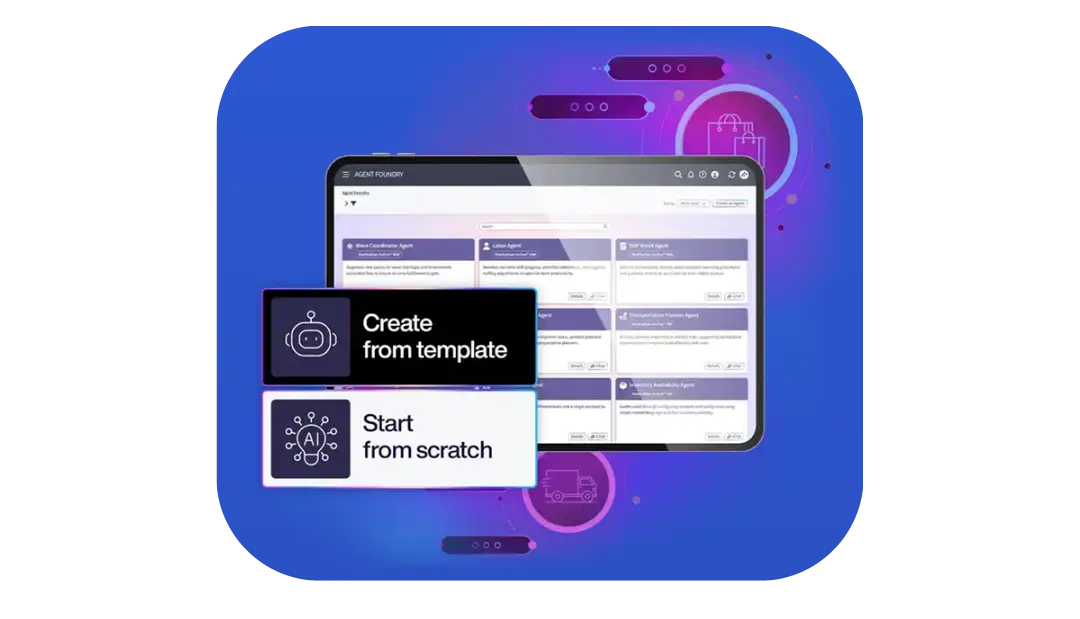
Manhattan Agent Foundry simplifies creation of custom AI agents for supply chain commerce that work exactly how, where, and when you need them.
"Agentic AI isn't just another feature; it's a transformative innovation capability tailored to redefine the future of supply chain commerce. By opening up Agent Foundry to our customers and partners, we're ensuring that AI agent creation will not be constrained by vendor development cycles."
Sanjeev Siotia, CTO, Manhattan Associates
Agent Foundry equips you to build agents for your organization.
Three Ways to Build
From AI (No coding required)
- Have a natural language conversation
- Agent Foundry creates what you need
From Template (Business practitioners)
- Start with existing agent
- Describe changes in plain English
- Helper agents build the new version
From Scratch (Developers)
- Fine-grained control over reasoning
- Custom business logic and workflows
- Direct API interactions
Four Key Development Capabilities
Visual Development
- Intuitive visual and declarative environment
- Eliminates traditional coding complexities
Unified Environment
- Combines deterministic business logic (API calls)
- Integrates with generative AI reasoning (prompts, LLM calls)
Composable Design
- Uses reusable components
- Employs existing agents, skills, and tools
Automatic Guardrails
- Enforces controls on agent behavior
- Ensures builders only access authorized systems
Eight Building Blocks Available
Reasoning
Incorporates LLMs using natural language
Workflows
Performs multi-step sequences with conditional logic
Tools
Invokes platform APIs and external agents
Data
Manages variables in agent memory
Communications
Delivers formatted text and alerts
Collaboration
Calls internal/external agents
Guardrails
Enforces business rules and approvals
Deployment
Publishes to marketplaces
Agent-to-Agent Collaboration
But agent-to-agent protocols extend that power across your entire technology ecosystem. Agent-to-agent protocols enable cross-vendor coordination through industry standards and marketplace integration.
Manhattan embraced industry-standard protocols enabling agents from different vendors to work together seamlessly. Two key standards govern this collaboration:
- MCP (Model Context Protocol): Governs how messages move between agents and systems, ensuring reliable, secure communication
- A2A (Agent-to-Agent Protocol): Defines how autonomous agents communicate and coordinate tasks in distributed environments
These protocols come to life through marketplace integration, where agents discover and connect with capabilities from thousands of vendors.
Google Agentspace Integration
Manhattan agents publish in AI Agent Marketplace, connecting to agents from over 3,000 software vendors:
- Salesforce
- ServiceNow
- SAP
- And more
This openness raises a question: does interoperability diminish the value of purpose-built platforms?
Interoperability enhances flexibility but doesn't replace the depth, security, and reliability of purpose-built platforms. Core WMS and TMS systems remain the backbone; agents add speed and intelligence.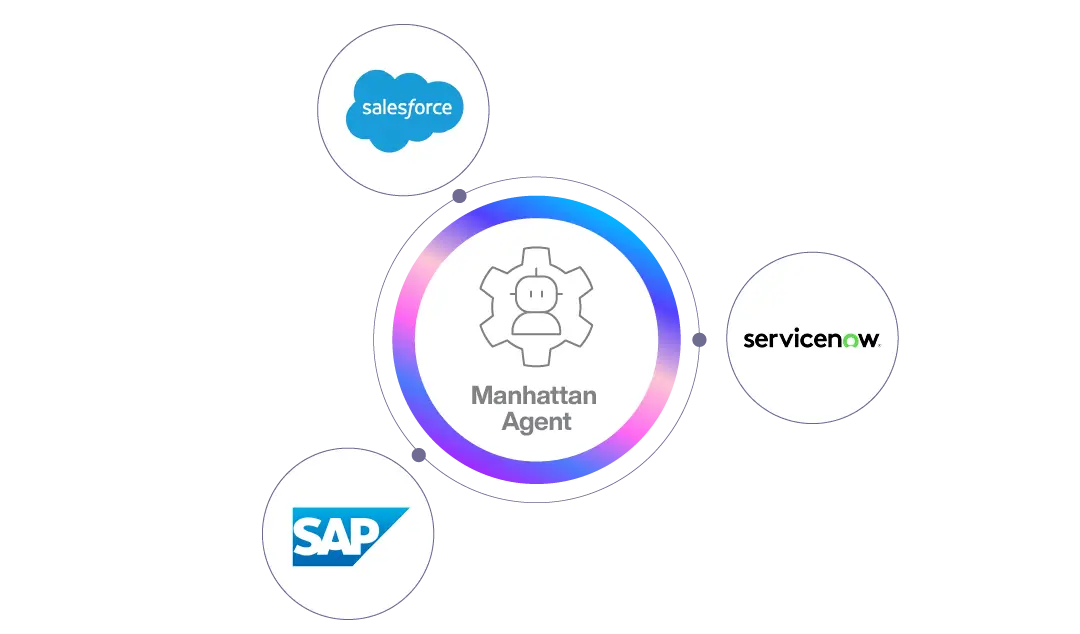
Manhattan Active Platform: The Foundation
Agent Foundry provides the tools to build agents. Manhattan Active Platform provides the foundation they run on.
Manhattan Active Platform uniquely unifies supply chain commerce functions on a single, API-first, cloud-native technology platform. Manhattan agents have instantaneous access to any data or function across every Manhattan Active solution, allowing agents to interact with the system and autonomously act.
Here's how the platform enhances each solution:
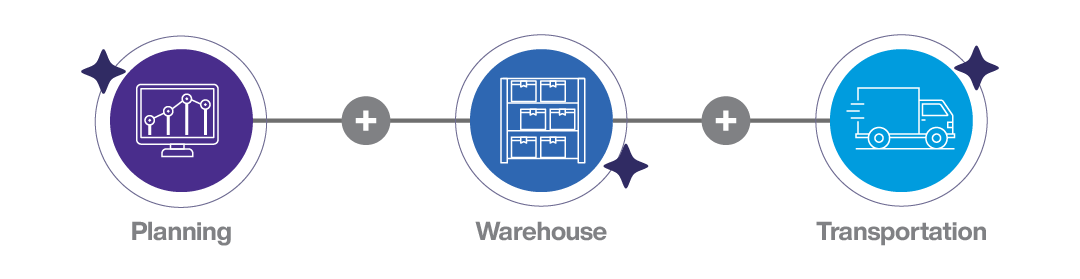
For AI in Supply Chain Planning:
- Unified demand forecasting, replenishment, and allocation
- Responsive intraday inventory optimization
- Continuous planning on real-time inventories, labor, transportation, facilities
For AI in Warehouse Management:
- Labor and automation orchestration
- Order Streaming enabling simultaneous processing
- WES Inside WMS unifying automation and robotics management
For AI in Transportation Management:
- Continuous optimization maximizing efficiency automatically in real time
- Carrier selection based on performance metrics
- Load optimization reducing emissions and carbon footprint
You've seen what agentic AI can do and how Manhattan enables it. But what does your infrastructure need to support these autonomous systems?
What You Need to Succeed
- Live Data: Real-time visibility through APIs (connections letting systems talk automatically) from operational systems—not overnight snapshots. Manhattan accesses live data directly.
- Clear Guardrails: Define when agents act alone vs. escalate, cost limits, service levels, override mechanisms.
- Security: Multi-layered safeguards—instructional guardrails, content sanitization, validated responses.
- Observability: Logs and decision trails for every action, backtracking capability, easy overrides.
- Deployment: Hybrid model—edge agents for microsecond decisions, cloud agents for data-heavy processes.
Expected Outcomes & Timeline
Measured Impact
Companies deploying agentic ai systems achieve 30-60% improvements in productivity and decision-making speed.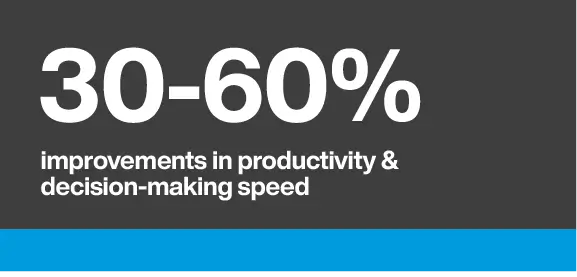
Four Improvement Dimensions
- Enhanced User Experience
- Gives intelligent, real-time support through natural language
- Anticipates needs, resolves issues faster
- Delivers 24/7 engagement tailored to preferences
- Accelerated Time to Market
- Automates routine tasks, streamlines decisions
- Analyzes data sets, identifies patterns fast
- Manages workflows, anticipates bottlenecks
- Provides real-time recommendations
- Improved Human Productivity
- Automates repetitive tasks, minimizes errors
- Offers intelligent real-time assistance
- Frees employees for high-value, strategic work
- Data Analysis & Insights
- Moves beyond static reporting
- Delivers dynamic, real-time insights
- Processes vast data sets quickly
- Alerts users to anomalies and opportunities before they happen
Industry Applications
Manhattan serves multiple industries with ai-enabled supply chain solutions:
Retail
- Seasonal inventory management
- Promotion planning automation
- Store allocation across hundreds of locations
- Automatic safety stock adjustments during peaks
Wholesale Distribution
- Multi-echelon network management
- Demand signal cleansing
- Regional distribution center optimization
Manufacturing
- Production schedule coordination
- Raw material availability tracking
- Finished goods distribution optimization
Third-Party Logistics (3PL)
- Multi-client inventory management
- Shared warehouse space optimization
- Transportation coordination across service level agreements
Additional industries: Consumer Goods, Food & Beverage, Grocery, Medical & Pharmaceutical, Trucking/Carrier Management
Maturity and Timeline
Expected outcomes matter. So does understanding where this technology stands in its evolution.
- Current (2025-2026): Young—comparable to early machine learning. Need "agent managers" monitoring behavior.
- Near-term (12-24 months): Rapid maturation. Vendors iterate quarterly, protocols standardize, best practices emerge.
- Long-term: Agentic AI represents a once-in-a-generation shift comparable to the printing press or smartphone introduction.

Conclusion: The Shift from Tools to Teammates
Agentic AI fundamentally changes the relationship between people and software.
Traditional software provides tools—you tell it what to do. Agentic ai in supply chain provides teammates—you define goals and guardrails; agents figure out how to achieve them.
This transforms how teams spend time:
- Planners move from firefighting exceptions to designing inventory strategies and optimizing supplier relationships.
- Warehouse managers shift from analyzing reports to coaching teams and implementing continuous improvement.
- Transportation leaders transition from reacting to disruptions to designing network strategies and negotiating partnerships.
The pattern: Agents handle the grind. People handle strategy, judgment, relationships—the work software can't replicate.
Agentic workflows turn scattered steps into automated loops across planning, inventory, warehousing, and transportation through ai workflow automation. They don't eliminate complexity—they navigate it.
The shift to an ai-enabled supply chain gives you better tools to handle what humans can't: processing massive data volumes in real-time, executing thousands of routine decisions flawlessly, learning continuously without fatigue.
This represents a once-in-a-generation opportunity. Organizations engaging now position themselves to capture compounding advantages as technology matures.
The competitive edge flows from building organizational capabilities: governance frameworks, agent management skills, portfolio thinking, and cultural comfort with autonomous systems working alongside people.
Ready to Build Your Agentic Supply Chain?
Your planning team deserves better than spreadsheets and firefighting. Your customers deserve faster decisions. Your supply chain deserves intelligence to run itself.
Manhattan's agentic supply chain solutions provide the platform for enterprise ai agents that turn planning into action, real-time data, clear guardrails, connected systems, and ai orchestration balancing cost, service, and sustainability.
Contact us today.
Frequently Asked Questions
No. Applications provide essential governance, structure, transactional integrity, and compliance. Agents transform how you interact with these systems, accelerating decisions and automating workflows. Applications provide the foundation; agents provide the intelligence layer.
No for basic customization. Business practitioners without coding knowledge can use template-based methods, expressing requirements in plain English. Yes for advanced customization. Developers can build from scratch with fine-grained control. Manhattan Agent Foundry offers both paths.
Yes. MCP protocols enable cross-vendor communication. Your WMS agent from one vendor could coordinate with ERP agents from another. Industry standardization expected within 6-12 months.
Partially. On-premises platforms lacking modern APIs and orchestration layers cannot support full autonomous loops. What you might gain: analytical insights through read-only agents. What you'll miss: automated execution, true orchestration, real-time responsiveness. Path forward: cloud-native platforms or significant modernization investment required.
Expected range: 30-60% improvements in productivity and decision-making speed. Variables: workflow complexity, data quality, organizational readiness, guardrail design. Measure your baseline carefully and track improvements rigorously.
Young—comparable to early machine learning (2010-2012). Rapid maturation expected over 12-24 months. Proceed with optimism and strong governance.
Each update requires regression testing and validation. Manhattan creates safeguards testing new model behaviors before production deployment.
Through retrieval-augmented generation (RAG) augmenting models with enterprise data and grounding validating outputs against trusted sources—ensuring accurate, reliable answers for mission-critical operations.