The Future of Customer Service is an Embedded Agent, Not a Super Bot
- April 24, 2026
- Ellie Crawford
- Read time: 3 minutes

Everyone wants AI to make their business more efficient. The easy answer looks like a single, universal enterprise agent that handles everything. But easy answers often create new problems.
Manhattan's Chief Prodct Officer Brian Kinsella makes a sharper argument: agents deliver real operational value when they live alongside the people they support. A general-purpose agent on a second screen does not remove swivel-chair work. It relocates it.
The customer service representative's (CRS's) core problem has nothing to do with the number of AI tools available. CSRs spend too much time identifying what went wrong and pulling data from multiple systems before they can even start solving the customer's problem. The research phase kills productivity and strains patience on both ends of the call.
An embedded contact center AI agent eliminates the research phase. It delivers actionable customer and order insights the moment an interaction begins, so CSRs spend more time resolving and less time hunting.
The result: faster handle times, higher customer satisfaction scores, and a better experience for both the customer and the rep.
CSRs get instant context
An agentic Contact Center Agent delivers: proactive insights before a CSR asks a single question. It pulls the customer's recent orders, purchasing patterns, and a history of CSR notes accumulated over time. The rep enters the conversation already knowing why the customer called.
This matters most in high-volume environments where CSRs handle dozens of interactions a day. Front-loading context compresses time-to-resolution and increases first-contact resolution rates without adding steps to the CSR's workflow.

Proactive order signals are surfaced before the customers speaks
The agent also monitors active orders in real time. It highlights why items are on hold or canceled and pulls carrier status updates automatically. By the time the customer describes the issue, the CSR already knows about it.
This shift from reactive to proactive service changes the tone of every interaction. CSRs move from catching up to leading the conversation.
Automate price adjustment requests
Yes, and the price adjustment workflow shows exactly why embedded agents outperform general-purpose tools. Consider a customer who bought a bag for $200 on Monday. By Thursday, the price dropped to $175.
Historically, a CSR would need to verify four things before approving any adjustment:
- Surface order details before the customer speaks
- Check whether the item qualifies under business policy (final sale items, for example, often do not)
- Verify the order falls within the adjustment window, typically within seven days of purchase
- Confirm the discount does not exceed the maximum allowed, such as 10 percent
The Contact Center Agent completes all four validations automatically. By the time the customer asks, the answer already exists. The CSR approves and moves on.
Get in-app SOP answers in real time
Customer service teams deal with constant change: distributed teams, high turnover, and large seasonal hiring waves. New reps cannot afford to search knowledge bases or interrupt a senior colleague every time an edge case comes up.
The Contact Center Agent answers questions about order data and business standard operating procedures directly inside the application. Guidance arrives in context, not in a separate browser tab or training document. Reps get the right answer faster, and the customer never notices the pause.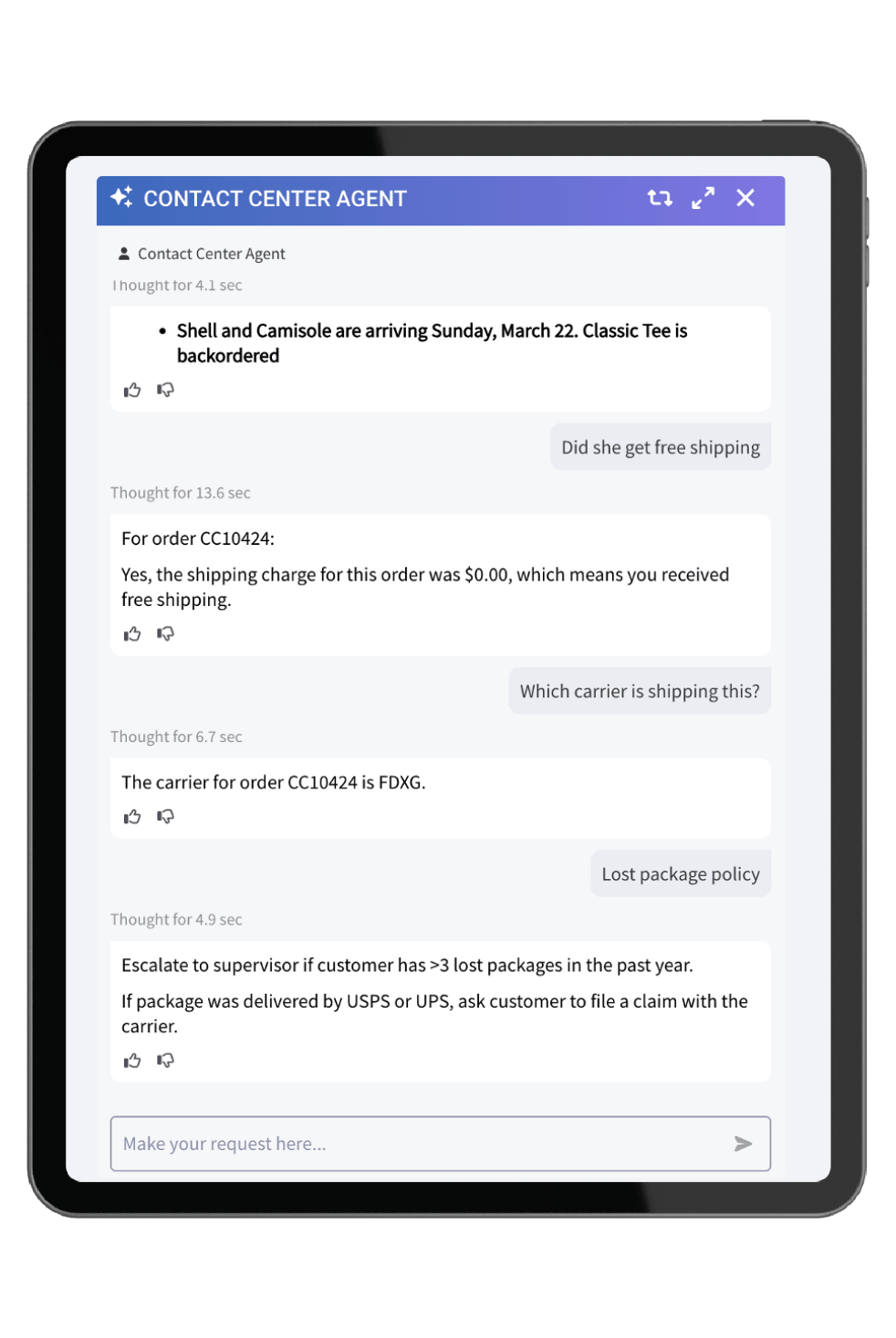
Get faster answers to oft asked questions
Customers often want one thing above all else: faster delivery. When a carrier falls behind or plans change - CSRs face a manual search through carrier options, store inventory, and fulfillment policies to find an alternative.
The Contact Center Agent handles that search automatically. If an order scheduled for April 1 needs to arrive sooner, the agent evaluates options in seconds: upgrade the shipping method, switch to local store pickup and cancel the original shipment, or other available paths. Once the CSR selects the best option, the agent updates the order. A research project that once took several minutes becomes a fast, confident yes.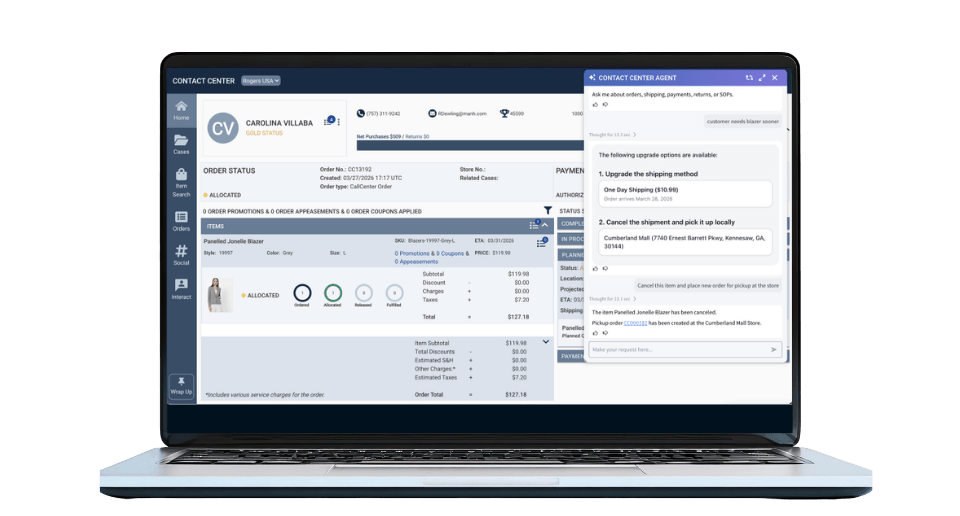
The future of customer service belongs to specialized, embedded AI
AI agents already handle much of the work before a customer reaches a CSR: tracking orders, initiating returns, updating preferences. For the customers who need more, an embedded contact center AI agent prepares the human rep to deliver it.
Not a super bot trying to do everything. A focused agent, working inside the tools CSRs already use, turning research time into resolution time. That is the operational shift worth building toward.
Frequently asked questions about contact center AI agents
A contact center AI agent works alongside customer service representatives (CSRs) inside the tools they already use. It surfaces order data, flags issues, and executes workflows on the CSR's behalf, before the customer explains the problem. Unlike a chatbot, it works on the agent side, not the customer side.
A chatbot handles customer-facing interactions: order tracking, simple returns, basic account questions. A contact center AI agent works on the CSR side, embedded in the rep's workflow, delivering proactive insights and completing backend tasks so the human can resolve issues faster. Both serve important roles. Neither replaces the other.
No. Embedded AI agents support CSRs, they do not replace them. Self-service agents handle straightforward queries independently. For complex situations that require judgment, empathy, or a policy exception, the embedded agent arms the CSR with everything needed to respond quickly and confidently.
The highest-impact automations today include: pre-populating CSR context with order and customer history, validating price adjustment eligibility in real time, identifying faster fulfillment or shipping options, and answering SOP questions without leaving the application. Any workflow that currently requires a CSR to switch systems or search for an answer qualifies as a candidate.
By removing the research phase from every interaction. Instead of spending the first 60 to 90 seconds pulling order data, the embedded agent surfaces it before the conversation begins. The CSR starts the interaction already informed, which compresses time-to-resolution and raises first-contact resolution rates.