You Manage the Intent. We Manage the Machinery.
Inside Solution Design Studio and why a business document, not a configuration screen, is now the starting point for enterprise software.
- May 19, 2026
- Sanjeev Siotia
- 5 minutes

Three years ago, on stage at our annual Momentum customer conference, I laid out a vision.
A system that could read a raw business requirements document and configure itself. No clicking through hundreds of screens. No translating what the business wants into what the software needs. None of the slow, painstaking work of bridging intent and execution.
This year, on that same stage, we showed it.
It is called Solution Design Studio™. And I want to take you inside it — because what we built matters a lot more than the demo.
Configuration is where speed-to-value goes to die
Let me start with the problem, because I think it is more expensive than most people realize.
Every enterprise software project carries a hidden tax. Somewhere between the moment a business decides how it wants to operate, and the moment the system actually runs that way, there is a long, expensive translation layer. Requirements documents become technical specifications. Specifications become configuration. Configuration becomes weeks — sometimes months — of careful, screen-by-screen work.
That gap is not a technical footnote. It is where the value of your investment quietly drains away while you wait for the system to catch up to reality.
So, we asked a simple question. What if the document itself was the configuration?

Start with a document, not a screen
Most enterprise software starts with a configuration screen. Solution Design Studio starts with a blueprint.
The blueprint is a living, business-language description of how your operation should run: in a store, a warehouse, or a transportation network. You can write it directly inside Solution Design Studio. Or you can hand it the operational documents you already use today. The ones sitting in your shared drive right now.
From there, the work shifts.
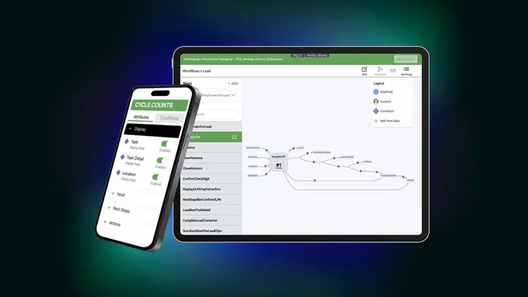
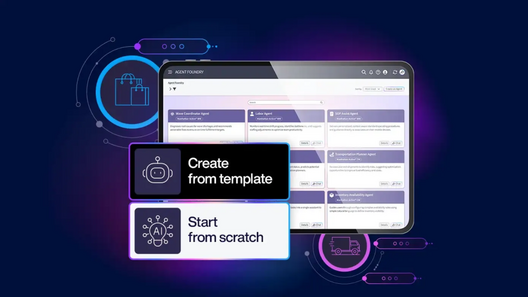
Our agents read the blueprint. They understand the intent behind it. They map out exactly how your operation needs to run, and they hand back a structured, natural-language design — not code, not a wall of configuration fields. You review it. You edit it. You approve it.
And when you are ready, you publish.
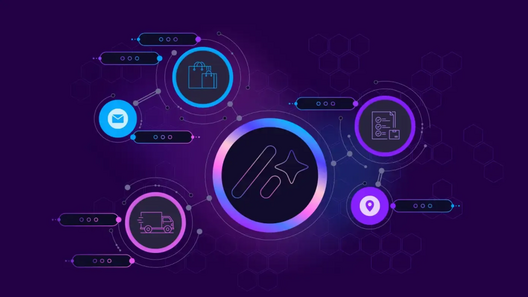
Behind that button is massive agentic workflows driving the hidden machinery: AI orchestration at scale. Hundreds of specialized AI agents form a true multi-agent system, collaborating in the background. They translate your approved design directly into live configuration across Manhattan Active® solutions. You manage the business intent. We manage the machinery.
We put it to the ultimate test
A bold claim is worth nothing without proof. So let me give you the proof.
During testing, we used a real solution design document from a real customer. But here is the twist: that document had been written to implement one of our competitor's solutions. It was not built for us. It was not tidied up for a demo. It was a raw operational document, written with a completely different system in mind.
We fed it into Solution Design Studio.
It read it. It understood the intent. And it configured roughly 90% of the requirements into a live, working ActiveWarehouse™ solution.
From a static document to a live, configured system — work that traditionally consumes lengthy configuration cycles, compressed dramatically. That is not a projection. That is something we are doing right now.
This is not AI bolted onto something old
I know what some of you are thinking. Every vendor is saying something like this right now.
So let me tell you what makes this different, because the difference is architectural.
Solution Design Studio is the next phase of our Agentic AI strategy, and it works because of a foundation we laid a decade ago, long before anyone used the word "agentic." It runs on an AI-native platform. Not an AI layer draped over a legacy system of record. The intelligence is part of the core, not a wrapper around it.
That distinction matters most when the agents do their work. They think using the language model. But when it is time to commit a configuration, they call on deterministic AI. It operates within defined guardrails and call deterministic logic the unbending rules of how your business actually works.
The outcome is not a creative guess. It is mathematically sound, every time.
In our industry, "almost correct" is the same as "wrong." We designed for that reality from the start. I call this our deterministic spine— and it is exactly what makes true operational autonomy possible without introducing new failure modes into systems that cannot afford them.
What this means if you run the business
For business leaders, the value is straightforward: far less friction between recognizing a need and implementing the change that meets it.
Supply chain and commerce environments do not hold still anymore. Conditions move fast, and design and configuration cycles have quietly become the thing that slows you down. Solution Design Studio lets your teams work at the level of intent, describing how the operation should run, while the platform absorbs the complexity of turning that intent into operational reality.
What this means if you build the systems
For developers and technical teams, this is not about removing your oversight. It is about giving you something you have never really had: a single, continuously evolving source of truth for operational intent.
The blueprint does not disappear after go-live. It stays. It becomes a persistent, business-language representation of how the operation is meant to run something your teams can review, extend, govern, and evolve as conditions change. Configuration stops being a one-time implementation event you finish and forget. It becomes living, editable, and always aligned to reality.
Where this is today — and where it goes
I will be precise about this, because precision is the point of everything we just discussed.
Solution Design Studio is already being used by our services teams in targeted implementations, accelerating real deployments today. Broader customer rollout follows in the coming quarters.
But step back from the rollout schedule for a moment, because the larger shift is the part worth sitting with.
For decades, humans adapted to the software. We learned its screens, its sequences, its quirks. We translated our intent into its language because it could not speak ours.
That is the part that is ending.
When the system can take business intent and carry it all the way through to live configuration, and do this safely, deterministically, continuously, the relationship inverts. This is intent-based configuration. The software adapts to you.
That is the North Star. And we are already executing on it.
We are not at the finish line. We have real work ahead. But the trajectory is set.
You manage the intent.
We manage the machinery.
Sanjeev Siotia is EVP & Chief Technology Officer at Manhattan Associates. Solution Design Studio is part of ActivePlatform™.