
Unified Commerce: How One Platform Powers Every Channel
Consumer shopping journeys no longer follow a straight line. Shoppers scroll on social feeds, watch product videos, browse apps, check stock on mobile, and visit stores, often looping back across channels before buying. These touchpoints overlap and repeat in unpredictable ways, and customers expect one smooth experience at every step. Fragmented systems create blind spots in inventory, orders, and customer history, triggering delays and broken promises.
Today's reality: The Unified Commerce Benchmark, sponsored by Manhattan, reports show that over 66% of consumers use two or more channels before completing a purchase. Unified commerce leaders achieve 1.5× the conversion rate of basic-maturity peers. They turn browsing into buying with real-time personalization and connected cross-channel experiences. These patterns reveal why retailers can't afford disconnected systems. How can they deliver one brand experience with data and inventory scattered across systems?
The answer starts with unified commerce. Commerce teams chase accuracy while demand spikes and volume swings, but siloed data blocks clear views of availability, capacity, and order status. Associates lose time, leaders debate numbers, and customers feel let down. Research conducted with analyst group Incisiv shows that only 7% of brands reach true unified commerce leadership, with the gap widening every year.
A unified commerce platform (UCP) powers the strategy, connecting systems and syncing actions in real time. The payoff extends beyond the leadership level. Gains compound from one maturity stage to the next, and the Developing-to-Advanced jump delivers increased revenue growth, improved customer satisfaction (CSAT), and operational efficiency. This article explains how unified commerce works, why platforms matter, the four factors that drive success, and how brands can build resilience across every system.
Key Takeaways for Retail Brands
- A unified commerce platform connects inventory, orders, customers, and stores in real time for accurate promises and seamless experiences. The 2026 Global Unified Commerce Benchmark shows that leaders grow 2× faster than basic-maturity peers globally, with $17M in incremental revenue per $1B at stake. In North America (NOAM), those gains reach 2.2× and $25M.
- Unified commerce solutions align systems like POS, OMS, CRM, and ecommerce into a single source of truth, improving planning, service, and fulfillment.
- Enterprise inventory provides one aggregated view of stock across the network, letting brands surface accurate availability across every channel and enabling reliable pickup, shipping, and transfers.
- Unified commerce delivers a consistent experience across web, mobile, and store, driving higher satisfaction and repeat purchases.
What Is Unified Commerce
Unified commerce means one connected operating model for retail. The approach links point of sale (POS), the order management system (OMS), the customer relationship management (CRM) system, e-commerce, and store operations, so teams act and plan off the same data. A unified system syncs signals across channels at the same moment, providing consistent service and dependable promises.
In the retail industry, challenges manifest in different ways every day. An item shows in stock online but not in store. A pickup order misses its window. A return falls into a dead queue. Unified commerce addresses these gaps through shared visibility and coordinated actions, helping leaders simplify planning, guide associates, and serve customers without switching tools.
Why Unified Commerce Matters Now More Than Ever
The definition only tells part of the story; the urgency behind it tells the rest. Retail stands at a crossroads where rising customer expectations, economic shifts, and fierce competition mean strategies from two years ago no longer guarantee success.
A stark divide has emerged between brands. Some accelerated growth with seamless, high-impact shopping experiences. Many others struggle to adapt, despite recognizing unified commerce's impact on revenue and efficiency.
The 2026 Global Unified Commerce Benchmark, spanning 400+ retailers across NOAM, EMEA, and Latin America, reveals that leaders who embraced transformation didn't just keep pace. They earned measurable gains across shopping, checkout, fulfillment, and service that separate them from competitors:
- 2× faster revenue growth globally (2.2× in NOAM) with 1.5× higher conversion rates through real-time personalization and AI-assisted discovery
- 8–13% higher average order values globally (22–65% in NOAM) without markdowns, through intelligent cross-sell and assisted trade-up
- Up to 23% higher customer lifetime value in NOAM through predictive personalization and intent-driven engagement
- 24% higher customer satisfaction scores in the US, with churn 13% below the global average (50% lower in NOAM)
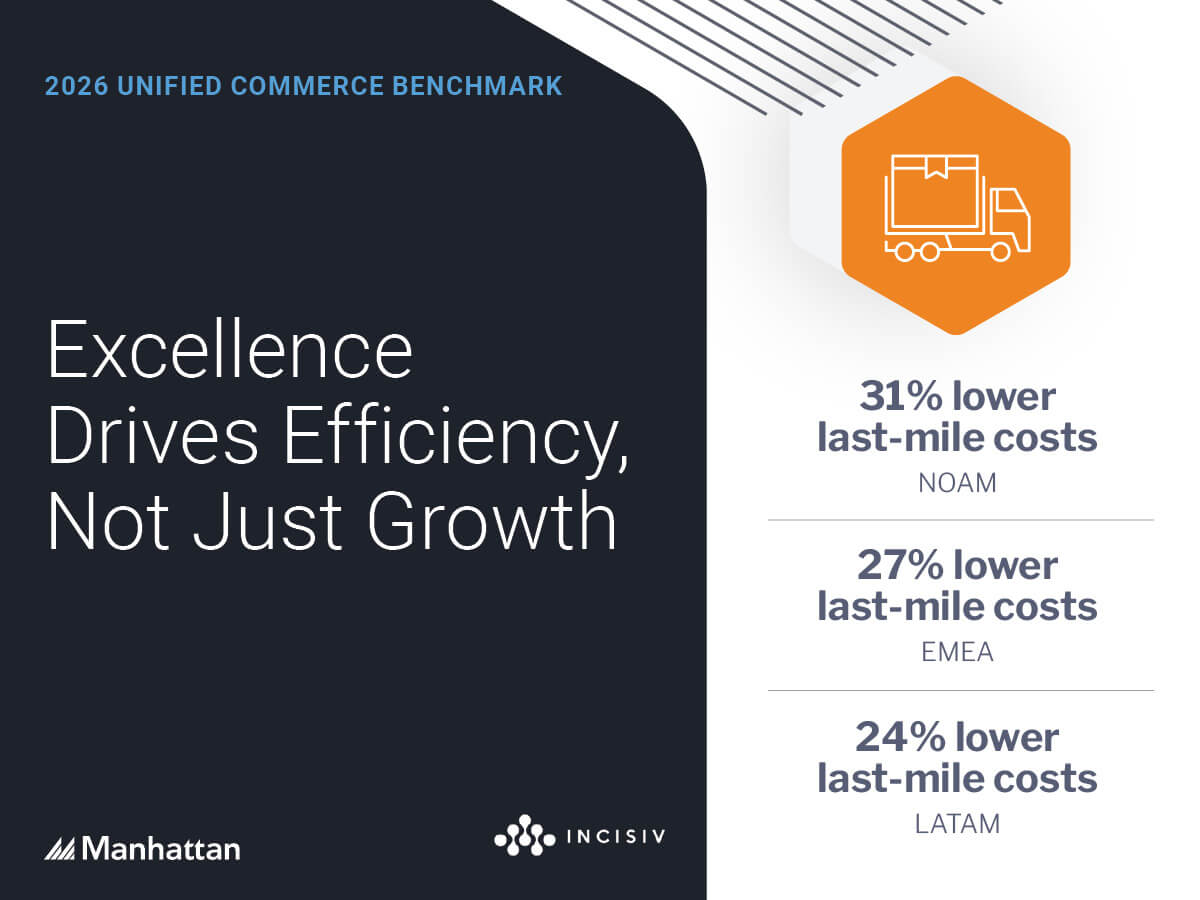
- Up to 31% lower last-mile fulfillment costs in the NOAM (27% in EMEA, 24% in LATAM) by converting stores into distributed fulfillment hubs
- Up to 50% higher inventory turns in NOAM (45% in EMEA, 27% in LATAM) through real-time visibility and dynamic allocation
- 62% of returns processed in-store in NOAM, turning the returns experience into a loyalty-building advantage
The 2026 benchmark also reveals that 38% of capabilities that defined leaders one year prior have already become table stakes. As expectations accelerate, retailers that delay transformation face a widening gap. No retailer in the benchmark jumped from Basic or Developing directly to Leading, reinforcing that sequential capability progression remains the only reliable path forward.
The lines dividing digital and physical retail will only continue to blur as the two channels merge into one experience. A unified commerce platform delivers on the promise of a consistent, convenient omnichannel shopping experience, whether online, on mobile, or in-store. Retailers need the right digital tools to unify the experience for associates and customers in today's hyper-convenience era. 
The Four Main Factors of Unified Commerce
These macro-level gains trace back to four foundational factors. Each factor enables unified commerce to deliver optimized scalability, adaptability, visibility, and seamless connectivity across customer and associate interactions.
-
Product Visibility
Enterprise-wide inventory visibility gives warehouse staff, retail associates, and customers access to critical product information. Teams and shoppers can see available product, locate items across the retail network, spot low-stock positions, and estimate fulfillment speed. A unified commerce platform lets customers access any ready inventory within the store network. Shoppers then choose the most convenient purchasing method for their needs.
-
Unified Channels
A single unified commerce platform lets retailers track all cross-channel purchases, sales, and promotions in one place. The platform accommodates omnichannel fulfillment options: buy online, pick up in-store (BOPIS); buy online, return in-store (BORIS); curbside pickup; ship-from-store; and endless aisle. Retailers also gain access to data from every channel to review performance and fine-tune inventory strategies.
-
Integrated Systems
A unified commerce platform integrates all backend and frontend systems into a single cohesive unit. Retailers can adapt and scale functionality to match their specific business needs. The platform unifies stores, customer services, and distribution processes without requiring multiple solution providers.
This integration gives teams access to actionable, enterprise-wide data from every touchpoint in a single view. Customer and inventory data flow together regardless of channel, improving decisions and response speed. One centralized platform also simplifies adding new technologies and receiving upgrades that keep pace with omnichannel trends.
-
Customer Engagement
Engaging customers across every selling channel and touchpoint unlocks customization and personalization throughout the buying journey. This engagement starts with a customer's first brand interaction and extends well beyond the sale.
Associates access a customer's order history, wish lists, cross-channel carts, brand interactions, and social engagement through store or contact center channels. This unified view builds a deeper understanding of customer needs, preferences, and buying patterns. Most importantly, it equips retailers to keep the promises they make to their customers.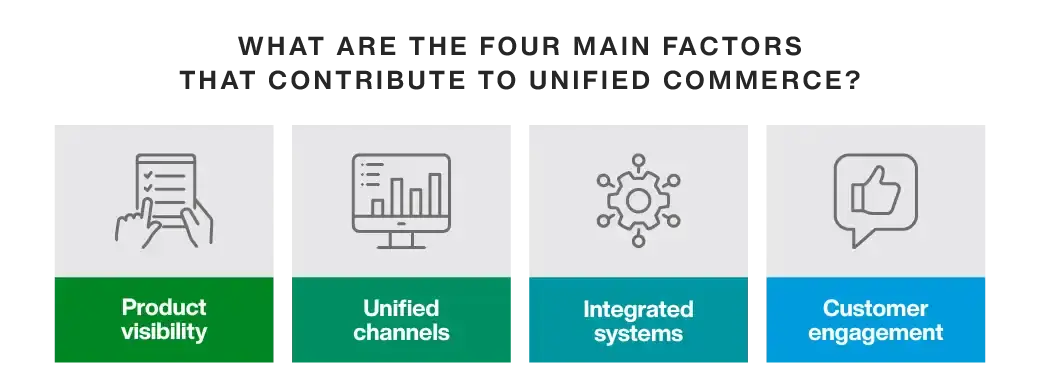
Unified Commerce Platform (UCP): The Backbone
These four factors come to life inside a unified commerce platform. The platform merges data from customers, inventory, orders, fulfillment, and stores, then exposes real-time views to teams. This connected backbone streams updates and routes tasks end-to-end, driving faster execution and fewer surprises.
Core unified commerce solutions work together as one: enterprise inventory, order management, customer profiles, connected POS, fulfillment visibility, and reporting.
Enterprise Inventory and Real-Time Accuracy
Enterprise inventory aggregates stock positions across stores, DCs, and dropship nodes, providing one single view for service and planning. Real-time accuracy updates counts across web, mobile, and POS together, reducing mismatches and manual checks.
For example: A limited edition hoodie sells fast online through social channels, and in store. Real-time sync protects promise dates and reduces shorts, cancellations, and customer disappointment.
Unified Order Management System (OMS) for Every Path
A unified OMS manages buy online, pick up in-store (BOPIS), ship-to-home, ship-from-store, and return anywhere, providing a single order view for associates and customers. Distributed orchestration directs orders according to stock proximity, capacity, and service-level agreement (SLA). The result: lower fulfillment costs and better on-time rates.
For example: A shopper's plans change, and they can no longer make their same-day store pickup. They switch to home delivery and request the item ship directly from the nearest location. The OMS reroutes the order to the closest store with available capacity, cutting miles and wait time while protecting revenue.
Customer Profiles That Travel Across Channels
Unified profiles bind identities across browsing, purchases, loyalty, and service, creating recognition and trust at every touchpoint. Insight pipelines segmented by behavior, value, and recency drive targeted offers and cleaner journeys.
For example: A frequent in-store buyer receives personalized promotions while shopping online. Relevant offers lift conversion, drive repeat purchases, and strengthen brand affinity A.
Connected Point of Sale (POS) Linking Store and Digital
A connected POS calls real-time inventory and order data during service, letting associates check stock, promise, and fulfill from any location. Unified workflows initiate fulfillment, transfers, or returns without switching systems, delivering faster service and fewer errors.
For example:The weekend rush hits, and a popular item sells out at one location. The connected POS surfaces current stock across nearby stores in seconds. Associates place pickup or ship-to-home orders from those locations and initiate inventory transfers on the spot. This visibility saves sales and keeps stock flowing where demand runs highest.
Fulfillment Visibility for Store and Warehouse
Workload views show pick lists, return queues, and slot volume by hour, creating smoother flow and predictable turnaround times. Lane routing directs parcels by capacity and SLA, reducing delays and improving on-time performance.
For example: Peak-season volume spikes with increased traffic at the warehouse and distribution centers. Clear queues and capacity signals keep teams focused, reducing labor inefficiencies and late shipments.
Enterprise Reporting That Produces Trusted Insights
Consolidated datasets join operational, customer, and product data under one model, delivering a single source of truth for analysis and planning. Decision dashboards track demand, speed, returns, and journeys, enabling faster actions and fewer disputes over numbers.
For example: Planning teams and leaders have access to live fulfillment data each morning, including on-time rates, cancellations, and capacity constraints. These insights drive labor and routing adjustments before the midday spike.
The Difference Unification Makes
Each of these components reinforces the others, and the contrast between unified and fragmented operations sharpens the point.
Without unified retail commerce: Disconnected systems duplicate inventory counts, split orders across channels, and hide available capacity. These blind spots lead to stockouts, late deliveries, and rising costs. Teams waste hours chasing mismatched numbers in spreadsheets and miss fulfillment windows.
With a unified commerce platform: Enterprise inventory supports clean picks, distributed orchestration protects margins, and unified profiles tailor service. The result: faster delivery, fewer surprises, and higher repeat purchase.
Consumer Benefits of Unified Commerce
Beyond connecting systems, unified commerce also shapes how customers experience your brand. When every channel shares the same data, retailers can personalize interactions and keep promises consistently. Those experiences determine whether a first-time buyer becomes a repeat customer. Key consumer benefits include:
- Customers research items online with real-time, network-wide inventory visibility. They then choose to buy online, pick up in-store, ship-from-store, ship to another location, or request local delivery.
- Associates deliver personalized service using real-time customer data, including purchase history, preferences, and habits, across every channel.
- Digital customers continue their shopping experience in-store, where they can modify their initial order or add items to their cross-channel cart. Associates gain cross-sell and upsell opportunities during pickup or checkout.
- Customers request fulfillment changes or order modifications through two-way communication with associates who adjust methods in real time.
- Customers initiate cancellations, modifications, returns, or exchanges after purchase through digital self-service, regardless of the original sales channel.
- Order-update notifications keep customers informed, with options to engage the contact center or associates for cancellations, shipping status, and order details.
Understanding why a customer shops with your brand lets you tailor experiences around their intent. Customers feel seen and heard throughout the buying journey when retailers put their needs first. That level of personalization and transparency builds the trust that drives lasting brand loyalty.
The 2026 Global Unified Commerce Benchmark, produced by Incisiv in partnership with Manhattan, surveyed 400+ retailers across the US, EMEA, and Latin America. In the US alone, research across 250 specialty retailers shows unified commerce leaders achieve 1.5× higher conversion rates than basic-maturity peers. Fewer than 5% of retailers globally offer dynamic, real-time personalization powered by GenAI. Among early movers, AI-driven personalization already delivers up to 8% revenue growth and up to 31% gains in operational efficiency.
Read about how Manhattan’s pre-built agents benefit retailers.
Solution Benefits of Unified Commerce
Unified commerce doesn't just improve the customer experience; it also transforms how retailers operate behind the scenes. The technological capabilities of selling on one unified commerce platform let retailers consolidate payment processing, streamline fulfillment, and drive connected retail solutions that constantly adapt. Key capabilities include:
- Global payment processing on a single platform lets associates manage and accept any payment type from any channel or region, with universal reporting data.
- Payment flexibility spans gift cards, loyalty points, store credit, mobile wallets, pay-later apps, and store credit cards in any combination.
- All business systems integrate on one platform, enabling retailers to scale and adapt functionality to match their needs.
- Cloud-native unified commerce platforms receive all updates and upgrades automatically, without disruption to daily operations.
- Accurate real-time inventory enables seamless stock movement based on demand or customer preferences for smoother fulfillment.
- A single view of order history, inventory, and analytics across channels provides precise data to predict future customer behavior.
These unified commerce capabilities define how customers shop and, in many cases, differentiate retailers who adopt a unified commerce approach.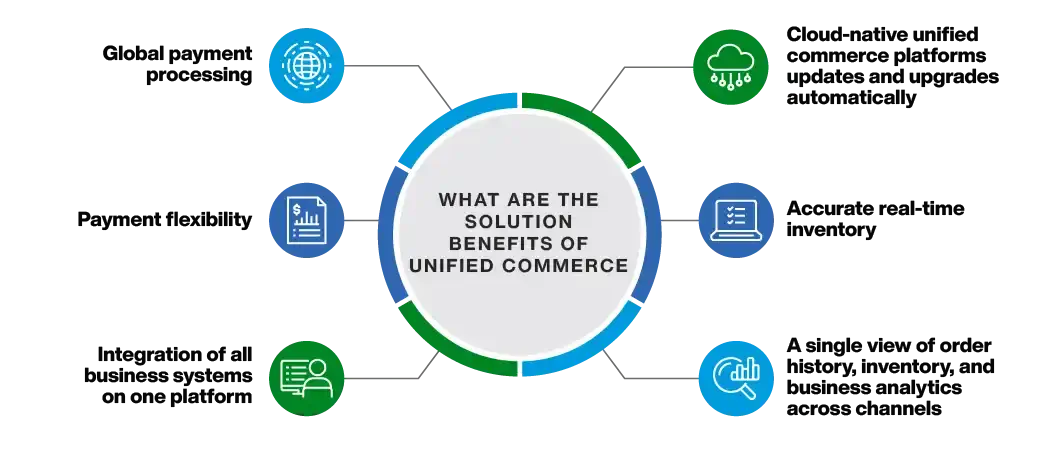
Real-World Success Stories
The proof of unified commerce shows up in real results. Two well-known retailers demonstrate how a unified commerce platform drives resilience and growth.
Brooks Brothers: Surviving and Thriving Through Disruption
Brooks Brothers, the oldest American apparel brand dating back to 1818, provides stylish modern clothing for men, women, and children. When the COVID-19 pandemic forced nonessential businesses to close store locations nationwide, Brooks Brothers had to pivot fast. The retailer shifted from a pre-pandemic 35% digital business to 100% digital overnight.
The shift triggered unprecedented supply chain disruption, leaving many businesses scrambling for answers. Brooks Brothers already had theirs in hand.
The retailer had selected Manhattan Active® Omni in 2018 to address its lackluster ecommerce fulfillment. Before Manhattan, Brooks Brothers ran one distribution center (DC) for ecommerce, stocked only with excess, out-of-season product from physical stores. That inventory sold at a discount, far from an ideal product life cycle.
Brooks Brothers spotted an opportunity to fulfill ecommerce orders directly from local stores using Manhattan Active Store Inventory and Fulfillment. This approach cut delivery times and let the retailer sell at full price from local locations, boosting margins. Little did they know, this omnichannel flexibility would also drive critical sales during the COVID-19 pandemic.
When store closures hit in 2020 with the holiday season looming, Brooks Brothers relied on Manhattan Active Omni. Rather than struggling to meet a flood of ecommerce orders with legacy software, the retailer thrived. Ship-from-store and in-store pickup fulfillment from closed locations kept orders flowing.
Brooks Brothers also simplified daily work for associates while positioning the brand for future success. A unified commerce platform provides versionless upgrades and capabilities tailored to the retailer's specific business needs. With an agile, evergreen solution at the helm, the oldest American apparel brand can keep its title moving forward, prepared for any unforeseen disruption or shifting omnichannel trend.
"Without having the scalability of Manhattan Active Omni, we never would've made it through that holiday season. However our customers want to shop, we can now support them. If we have the inventory and they want it, we can get it to them. We also have a good path forward for what comes next. We'll have a unique situation where we have OMS, promotion, store inventory management, and point of sale all connected. From an endless aisle perspective, I like to call that The Holy Grail."
— Todd Treonze, Senior Vice President and Chief Information Officer at Brooks Brothers
Watch the Brooks Brothers success story.
PacSun: A Direct Endorsement
Fashion retailer PacSun gave an even bigger stamp of approval for what unified commerce enabled their stores to achieve:
"Ship from store saved the company."
— Michael Relich, Co-CEO, PacSun
Watch PacSun’s success story.
Unified Commerce vs. Omnichannel
Real-world wins like these make the case for unification, but the term itself often sparks confusion. Retailers frequently use unified commerce and omnichannel interchangeably, yet the two represent distinct approaches to integrating sales channels.
Omnichannel focuses on delivering a seamless customer experience across platforms like online, in-store, and mobile. The approach ensures consistent interaction regardless of channel and emphasizes experience design.
Unified commerce takes integration further by consolidating all backend systems into a single platform. The approach unifies customer data, inventory management, order processing, and payment systems. Real-time visibility and agility span the entire business, with system connection at the core.
Connected systems enable execution that supports omnichannel journeys, delivering reliable operations and fewer handoffs.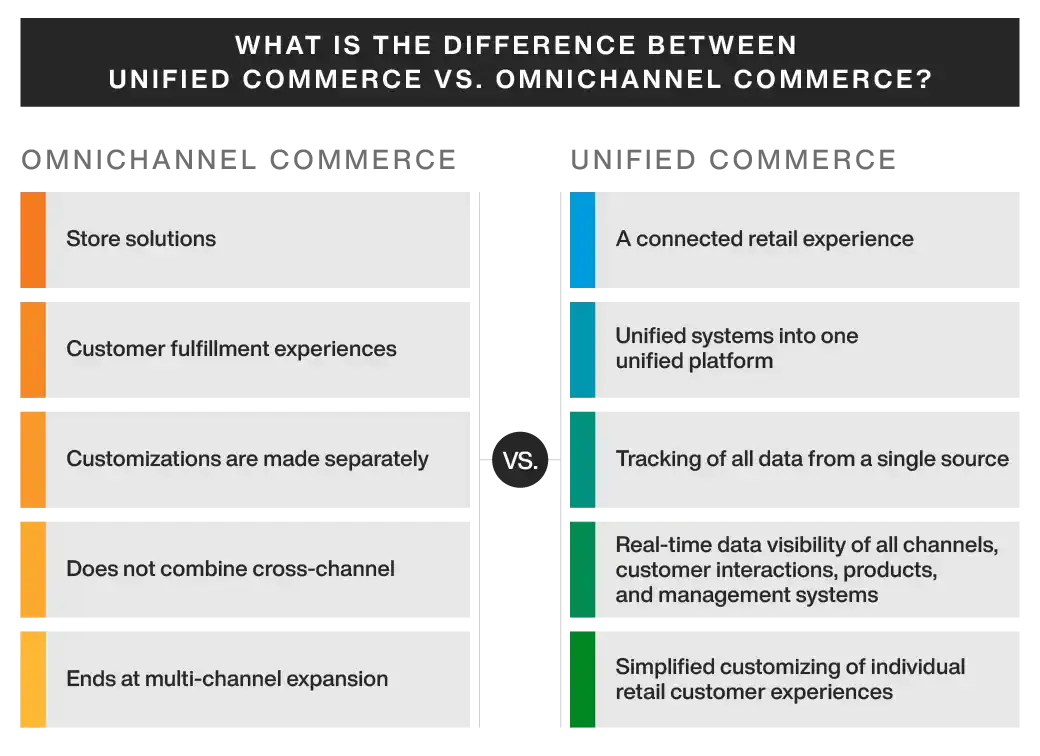
Implementation Challenges
The strategic distinction clarifies the goal, but reaching it requires careful planning. Implementing unified commerce poses several challenges:
- Complex technology migrations often require replacing or consolidating legacy systems.
- Data integration demands meticulous planning to ensure accuracy and consistency across all touchpoints.
- Organizational alignment means processes and employee training must match the new system for full operational synergy.
Despite these challenges, companies that successfully adopt unified commerce unlock superior customer experiences, streamlined operations, and stronger responsiveness in a competitive marketplace.
Getting Started: Change Management and Phased Rollout
Overcoming these challenges calls for a structured approach. Three pillars guide a successful launch.
Change Management and Adoption That Sticks
Clear playbooks train associates and leaders with role-based steps and quick wins. This approach drives adoption that grows week by week and sustains long-term results.
Phased Rollout
A phased rollout launches enterprise inventory and OMS in select regions first, then expands to CRM and POS. Controlling risk at each stage ensures steady gains without operational disruption.
For example: Teams start with live inventory and simple pickup flows, learn the rhythm, then add ship-from-store and unified returns after the first cycle.
Feedback Loops
Feedback loops capture store and customer signals, then adjust routing rules and workflows based on findings. Teams publish updates weekly, creating smoother operations and higher satisfaction across unified retail commerce.
The Path Forward
With a clear framework for getting started, retailers can focus on the long game. Legacy stacks struggle under fluid shopping behavior as customers switch channels in seconds and expect continuity. Teams need unified data to plan, promise, and serve in real time.
A unified commerce platform turns strategy into daily execution. This connected backbone links inventory, orders, customers, and stores under one umbrella, delivering clarity, speed, and trust across the enterprise.
Brands face a clear path: move from channel-by-channel fixes to unified retail commerce. Start with enterprise inventory and OMS, extend to CRM and POS, and align reporting around one truth. The result: cleaner availability, reliable routing, and service that keeps its promises.
Frequently Asked Questions About Unified Commerce
Unified commerce brings POS, OMS, CRM, ecommerce, and store operations under one connected model. A unified system syncs data across channels at the same moment, ensuring consistent journeys and dependable service.
The platform delivers the backbone for unified commerce. A connected environment streams signals and coordinates actions in real time, delivering accurate promises and faster fulfillment.
Omnichannel emphasizes experience design; unified commerce emphasizes system connection. Connected systems enable execution that supports omnichannel journeys, delivering reliable operations and fewer handoffs.
Shared visibility exposes inventory, orders, and capacity in one view. This alignment helps stores, digital, supply chain, service, and merchandising teams cut cycle times and act together.
Phased deployment begins with enterprise inventory and unified OMS, then connects CRM and POS. This approach delivers value in controlled steps for steady gains and lower risk.
KPI discipline tracks on-time rates, cancellations, units available to sell, and NPS weekly. Clear evidence of impact enables faster adjustments across the operation.
Manhattan Active Omni: The Ultimate Unified Commerce Platform
For retailers ready to act, one platform brings unified commerce to life. The Manhattan Active Omni suite is built to deliver optimal omnichannel retail experiences with a unified commerce platform that profitably connects every aspect of your retail network. Born in the cloud, Manhattan Active Omni provides a comprehensive portfolio of always-current, fully extensible solutions and services.
Its omnichannel software solutions, including Customer Engagement, Point of Sale, Store Inventory & Fulfillment, and Order Management, deliver a unified approach to selling, engagement, and fulfillment in a single cloud-native app. Manhattan Active Omni provides the flexibility and scalability to equip associates with everything they need to navigate the omnichannel world and deliver truly omnichannel customer experiences for today's and tomorrow's retail shoppers.
Want to learn more about how Manhattan Active Omni can help your stores? See how PacSun improved its in-store experience and achieved its highest Black Friday performance ever with Manhattan Active Point of Sale.
Ready to build your unified commerce experience? Request a demo or contact us below to unlock your optimized unified commerce journey.
Deliver on Your Promise to Customers
Get in touch with the Manhattan team to see how we can help.
Unified Commerce Benchmark 2026
Related Insights

Five Fulfillment Truths from the 2026 UCB
Discover five key fulfillment insights from the 2026 Unified Commerce Benchmark and why leading retailers are moving to a unified platform for faster growth.

Fulfillment's Future Starts with Your Foundation
Learn why the future of retail fulfillment depends on a unified commerce foundation that connects inventory, orders, stores, AI, and customer promises.