AI Can Coach Every Store Associate. But Only If It Lives in the Right Place.
- April 17, 2026
- Brian Kinsella
- Read time: 3 minutes

Last month I talked about the Wave Coordinator Agent and what it looks like when agentic AI lives within the workflows of users in the DC. Today I want to shift the venue from DC floor to store floor, still focusing on the possibilities of AI for frontline workers.
The store associate and the store manager are the two personas I'm focused on. And the question I keep coming back to is: what happens when an agent lives inside the work itself, not alongside it?
The answer isn’t more data. It’s smarter delivery.
Let’s consider each one in turn, starting with the store associate. After 30 years in the DC associate business and about 10 in the store associate business, the abiding theme of optimum experience design is ‘put ‘em on rails.’ In other words, design process flows that makes transactions fast and simple, with decision making kept to a minimum.
The reasons this approach is preferred are numerous, and include speed, the ability to focus on the customer/surroundings while using the application, and limiting the training requirements for these historically high turnover positions.
As we think about how to apply agentic AI, it does create a bit of a quandary, though. How do you apply a technology which ostensibly helps us make decisions more quickly and effectively, when the goal is to design the overall experience to minimize the need to make decisions at all?
The answer lies in taking existing flows and experiences and identifying points at which curated and relevant additional information moves the sales and service needle.
Let’s talk about 2 high level areas of opportunity in more detail:
- Taking another swing at personalizing the experience inside the store, and
- Embedding sales coaching right into the Point of Sale system.
Personalization has always been the goal. Implementation was the problem.
Personalization has been a goal of physical and digital merchants for two decades. The reason it hasn't delivered in-store isn't the idea, it's the implementation. We’ve all been on the receiving end of truly personalized service. We inherently understand the power and advantage of delivering an experience that feels friendly as much as it does transactional.
Leaving the digital channel aside, why has in store personalization had such limited success thus far? There are several factors in play, one of which is our instinct as software providers to provide masses of data on a customer dashboard.
We then hand this dashboard to a store associate and to tell them, effectively, scan these 15 data points in three seconds and build a mental picture of who you’re interacting with.
It’s not a fair ask, and it’s not surprising that most associates stop trying to leverage the data.
Now consider what a Store Associate Agent can do. Forget the 15 data points on the customer dashboard. Store Agents can consider transactional level data and metadata associated with that customer (from all channels) and present a concise, cohesive snapshot of the customer at hand.
Purchase tendencies (categories, colors, price points) and delivery preferences are expressed not in metrics in charts, but in plain language and with specific recommendations.
For the store associate newer to the role, the agent can offer verbatim scripting for cross-selling. And with the right design, the store agent can follow a progressive disclosure paradigm, taking the associate deeper in various directions on demand, all the while minimizing keystrokes.
The result is an interaction that feels personalized, natural, and is oriented around selling and service best practices as defined by that particular merchant.
And back to the theme of embedded experiences, these timeline insights are delivered in the application I’m already using to ring a transaction, handle an exchange, or provide some ancillary service for the customer in the store now. Make it easy, make it obvious, and make it helpful. Agents simply must live in the transaction flow to accomplish 2 of the 3 key objectives above.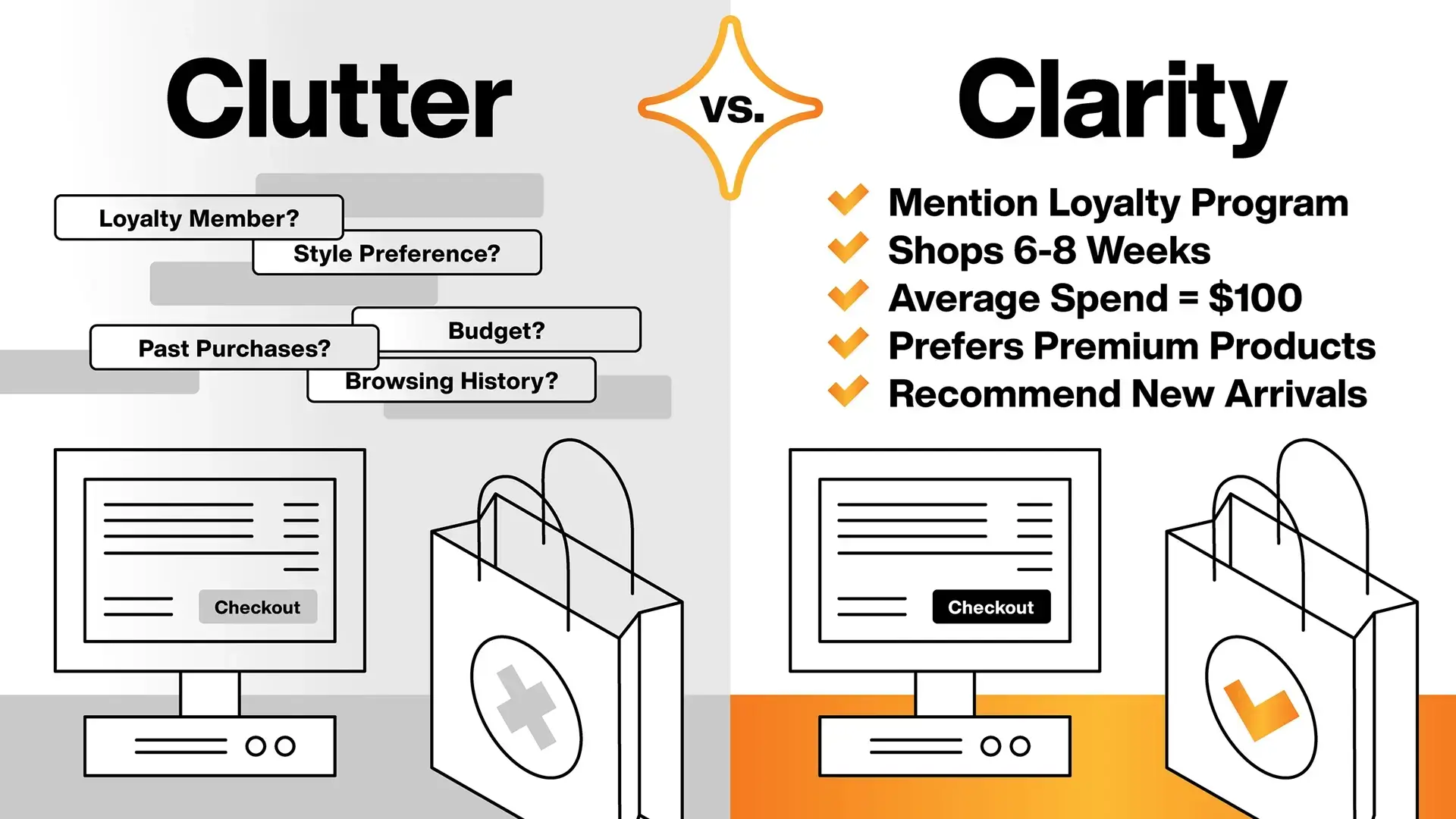
Now consider what happens when coaching scales beyond the manager
Next, let’s think about how the store associate and their teams keep tabs on how they’re performing. Best in class point of sale systems have embedded real-time sales performance analytics for years. Knowing whether you’re on pace to meet your targets should only be a tap away.
But then what? What do I do if I’m behind? Today, it’s largely up to the store manager to understand sales performance and provide ongoing coaching and suggestions. It works in principle, but it’s not terribly scalable.
Now consider how an agent might help. A sales coaching skill within the store associate agent can do things like understanding where an associate or a store is underperforming relative to others in the fleet, and to provide pointed recommendations about what’s working for others.
Maybe it’s a particular cross sell combination, a style which is working well in a particular region, or habitual usage of endless aisle selling which is making the difference.
Agentic skills can recognize these behavior differences in real-time, and quickly cross pollinate today’s best practices to a limitless number of store associate recipients.
And on top of a unified commerce platform, those agentic insights come not just from the brick and mortar selling channels, but from all commerce transactions in real-time.
Agents can suggest styles and SKUs which are selling well online in that associate’s metro area. Agents start with the depth of data that only lives inside the platform; transaction history, real-time cross-channel performance, associate behavior patterns across the fleet.
External signals like category trends, regional weather, and upcoming events are the layer the agent can layer on when relevant. The platform data is the advantage. External data extends it.
A Store Associate with access to the right real-time underlying data can dramatically change hour over hour selling behavior and performance.
We also need to consider that selling techniques, styles, and ‘vibes’ vary widely across merchants. The amazing thing about a fine-tuned agent is that these selling and service approach preferences can be fully accounted for. In fact, simply uploading a merchant’s SOP, training, FAQ, etc. documentation is enough to make the selling guidance highly merchant specific.
This tailored, specific and timely selling advice is best delivered in the line of business application. Meeting the associate where they are with selling advice in the transaction flow, dramatically reduces the ‘shelfware’ risk, and turns theoretical benefit into operational results.
Learn more about Manhattan Active® Point of Sale and how the Store Associate Agent works in practice.