Everyone Has an AI Foundry. But Where Should Agents Actually Live?
- March 19, 2026
- Brian Kinsella
- Read time: 6 minutes

As you might imagine, I spend a fair amount of time these days discussing agents with our customers. The conversations are wide-ranging, with a seemingly ever-shifting trajectory. We talk about the various types of agents (interactive vs. autonomous), how our customers have the flexibility to adapt agents to their environments, and, of course, the more mundane yet important topics of security, privacy, and governance.
Amongst these discussions, one recent customer visit stands out as being a bit spicier. An AI leader at one of our apparel retail customers asked me directly, “Why does every software vendor I meet with want to tell me about their ‘Foundry’? Everybody has a foundry. And most of you guys have probably never even seen a real foundry. It’s all a bit much.”
He had a point. The closest I could offer is the metal stamping plant, a few blocks from my house in Chicago's Bowmanville neighborhood.
He also had a valid point about “foundry proliferation” at software companies. If only the recent manufacturing reshoring efforts were as successful with actual steel foundries as software vendors have been with “onshoring” their virtual equivalents.
Leaving metaphors aside, there’s a real question to contemplate here: Where in the enterprise IT stack should agents be built and maintained? And how will they be made available to end users?
Ultimately, most major enterprise applications will need to offer their own agentic creation and maintenance capability, if they don’t already. And the reason for this is simple:
Agents deliver the most operational benefit when they live alongside the users they’re designed to help.
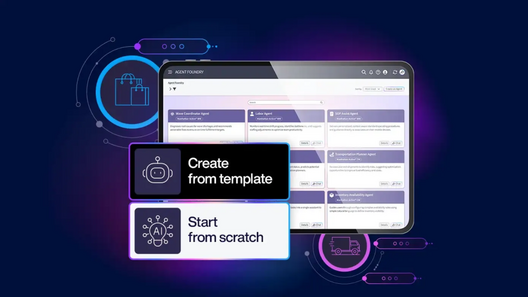
And if you believe that, it stands to reason that our customers will need the ability to create and maintain agents directly within our platform, rather than using an external agentic platform.
While external platforms from the likes of Anthropic, OpenAI, Google, Microsoft, Glean, and others certainly have an important role to play, they are not the right tools to help frontline associates derive maximum benefit from agents in their daily workflows.
I’ve heard many customers over the last few years tell us they want our technology to help them “meet their customers where they are.” Meaning, they want us to make it easy for their customers to discover, buy, take delivery of, and receive service on what they sell.
By reducing friction in commerce, their customers will naturally interact more, buy more, and have a more positive experience with the brand.
The same can be said of the relationships between agents and their associates. As a provider of AI Agents:
- We need to meet them where they are.
- We need to meet them in their workflows, while they’re in the middle of a task or transaction.
- We need to show up in the systems where they spend 80% of their working minutes every day.
- We need to be present at the point of sale during checkout, in the contact center during a customer call or text, in the warehouse while picking and packing is happening, etc.
Everywhere and all the time, and available with very low friction.
Opining on ideal human-agent interaction, I think it was Balaji Srinivasan, American entrepreneur and former chief technology officer of Coinbase, who first used the phrase “middle to middle.” This framing refocused the conversation away from the notion of “end-to-end/no human involved” agentic processing.
I’ve always really liked this framing because it makes it clear that agents help associates improve speed, accuracy, and efficiency. They’re a force multiplier not just for efficiency but also for human effectiveness.
And while agents will eliminate some tasks entirely, their greater impact will be to dramatically improve outcomes as humans continue to perform the tasks that aren’t going away.
To put even a finer point on it, let’s consider some of the middle-to-middle agentic flows we’ve shipped in recent quarters.
For this article, we’ll keep all of our operational examples within the warehouse. So, the agent to associate interactions we discuss will focus on warehouse associates.
It starts with effectively getting work to the floor, and agents can help here.
Let’s consider a day in the life of the individuals who plan and manage the waving process in the distribution center. From selecting orders, executing the wave itself, and most critically, troubleshooting issues with inventory availability and status, resource availability, and cut-off times.
The impact of the wave planner’s ability to keep the most important work flowing to the floor spans far beyond their own efficiency. It impacts the utilization and efficiency of literally hundreds of associates on the floor. It also impacts customer experience via on-time delivery and order cycle time.
Now consider how an onboard Wave Coordinator Agent can help.
This agent identifies issues with inventory before a wave is run and presents those issues for proactive review. It offers to take action to remediate those issues, maximizing both throughput of the wave and the availability of tasks for associates on the floor.
For those lines that still have issues post-wave, the Wave Coordinator Agent presents that data in a dynamically laid out interface, walking the associate through the process of remediating issues and making tasks available.
In both the pre- and post-wave scenarios, it’s the associate and the agent working together that solves the problems most effectively. The agent helps in the middle, to again reference Balaji’s idea. And that can only really happen with a Wave Coordinator agent who’s “riding along” with the associate through the waving process, actively making recommendations and troubleshooting based on how that specific DC is intended to process orders.
None of that context—the DC’s order processing rules, inventory state, associate availability—exists in an external platform. It only exists inside Active Warehouse. So in addition to the experiential benefits of being embedded, the agent’s recommendations are substantially more relevant and helpful.
Let’s now move our story along to the execution of the work itself.
If you’ve operated a warehouse before, you know that keeping staffing allocated across job functions in line with current workload is one of the trickiest, ever-present problems. Leaving aside the fluctuations in attendance and performance of the associates, order volume and order characteristics often vary significantly throughout a multi-shift day.
With the recent introduction of our Labor Agent, supervisors in DCs that are running our Active Warehouse application now get staffing change recommendations sent to them proactively throughout the day. What’s more, the agent can actually suggest which specific associates to move based on their prior training, certifications, and even productivity in the target job functions. Maintaining proper staff allocations throughout the day improves overall DC productivity and throughput, associate morale, and customer outcomes.
Finally, let’s now consider the warehouse associates working on the floor.
Armed only with a Zebra Android device (or similar) for the duration of their 8- hour shift, most associates never even navigate away from the Active Warehouse, much less use a secondary device. Agentic AI has but one way to come to life for them: on the mobile device and within Active Warehouse itself.
That’s where the Warehouse Associate Agent comes in (we like to keep our naming simple around here).
After a quick upload of a customer’s standard operating procedures, training documents, etc., warehouse associates can now verbally ask questions like:
- “Remind me where to induct this tote after I finish my picks in this zone?” or
- “Where exactly do I stick the label on this box?” or
- “My battery on my device is almost dead. Where do I go to get a new device?”
And while these types of questions can arise with any associate, it’s usually the less experienced team members that benefit the most.
In a higher-than-average turnover environment like the DC, getting new associates up the productivity curve quickly is one of the highest impact improvements any operator can affect.
An agent living outside Active Warehouse can’t answer those questions in context, mid-task, on a Zebra device. The only way this works is if the agent is native to the application the associate is already working in.
Finally, a word on the role of enterprise application-agnostic agentic platforms, such as those offered by Google, Anthropic, OpenAI, and others.
They undoubtedly have an important role to play, albeit at a higher level in the enterprise stack. Use cases such as inquiry and problem-solving, which require data and actions from multiple enterprise applications, are a great target for these types of platforms.
That’s why we build all our agents to be accessible via the MCP protocol. We anticipate our agents providing significant value not only to the associates they serve every day, but for other agents throughout the enterprise ecosystem.
The three examples above of embedded, immersive agentic experiences demonstrate the power of middle-to-middle, agentic-assisted workflows.
Middle-to-middle magic happens when agents live inside the applications associates use every day, when they’re adding value within existing, repetitive workflows. And perhaps most importantly, the magic happens when associates get the point of not wanting to execute those flows without the help of their onboard agent.