Why is everyone asking the wrong question about agentic AI?
- March 30, 2026
- Read time: 3 minutes

“What AI solution should we buy?” It’s the question being asked in C-suites around the globe. It’s affecting stock prices and futures markets. It’s changing businesses, propping up GDP and…
…it’s the wrong question to be asking.
Because the success your company can see from AI isn’t so much about whether AI can do what you need it to do. It’s about whether your organization can do what AI demands of it.
In the rush to adopt an AI solution, there’s been a tendency to see the choice of an AI solution as a magic bullet, something any company can bolt-on to their warehouse operations, transportation management systems, or stores, and have it solve all their problems.
But picking one technology over another isn’t the determining factor in AI success. The way your company currently operates is. Adding agentic AI to a weak foundation only hinders AI’s ability to do its job. You first need to ask the hard questions of your business to really understand what you can expect when adding agentic AI to supply chain operations.
Not every company will benefit equally from this agentic AI pivot, because not every company is organized in a way to take full advantage of it, especially in supply chain operations, where figuratively (and oftentimes literally), the rubber meets the road.
AI coupled with a fragmented tech stack is still a broken tech stack. AI can’t do the work it needs to do when systems aren’t connected across an organization. Any initial gains from an AI solution will hit a wall and hit it fast. It takes truly unified platforms to give AI the full visibility it requires. Solutions stitched together over the years that don’t communicate well prevent AI from seeing the whole picture.
Another overlooked factor: How clean is your data? Even with unified systems, if AI is dealing with dirty data, efficiencies are lost, opportunities get missed, and you lose a big part of the benefit that AI can offer.
While both unified platforms and clean data may seem like obvious, important steps, there’s an even bigger question: Is your business actually ready and able to do that? Can they all work together to integrate AI properly? Otherwise you end up back in silos without the exponential benefit of everyone working in unison.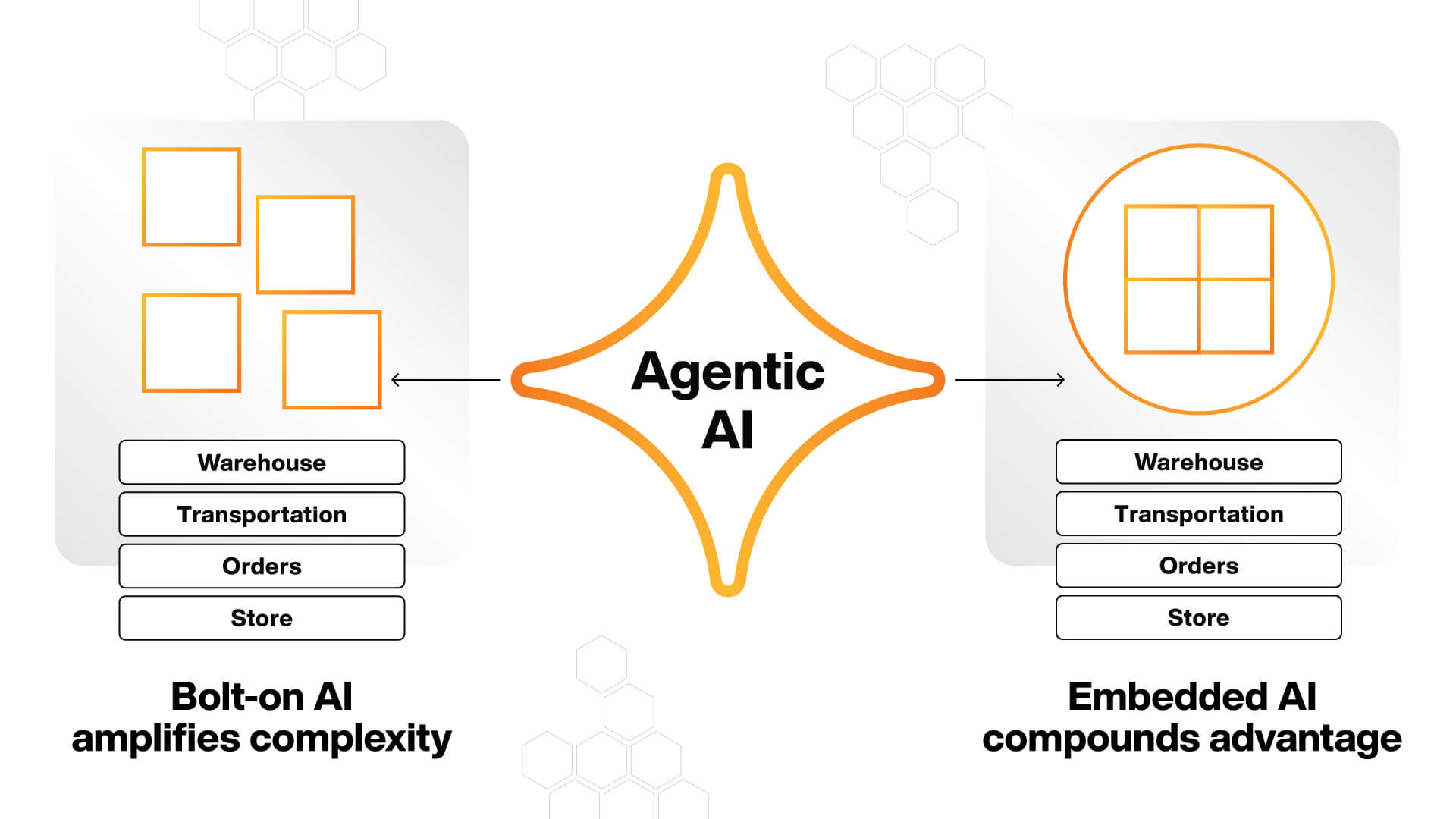
“Whoever simplifies fastest wins.”
System complexity, how simple you make your systems, is the hidden factor in the agentic era. Companies that can do the work to simplify their systems and approaches will benefit more no matter what AI solution they end up choosing.
It’s a truth that far too many companies are ignoring. AI needs cleaner, simpler systems to provide the gains businesses want. Interface-centric, configuration-heavy legacy software is objectively incompatible with the agentic AI world. Its value will swiftly erode as AI adoption velocity increases.
However, API-first, unified, cloud-native software is where agentic AI thrives, and the value of this kind of extensible, resilient software will explode. With agents living inside the systems that own the work—as well as having native access to real-time data and executional APIs, AI performs its best. Agents can be configured to think, see, and do a vast amount of tasks in your supply chain, but they still need to work in conjunction with a robust, structured software solution to actually execute those tasks.
Once you set yourself up for success, agentic AI can compound those wins. Reduced systemic friction speeds adoption and provides a better user experience. Broader adoption leads to productivity gains. Increased productivity means faster time to market. More velocity means more data, deeper knowledge and better results.
In the supply chain world, these four outcomes are not independent benefits: enhanced user experience, increased productivity, faster time-to-market, and deeper data understanding. Together they create a compounding flywheel that supercharges operations and makes the real, durable gains you want. In a fragmented system—even one aided by AI—wins in these four areas are not only harder to come by, but they also don’t compound in the way they do for simple, connected systems.
And as anyone managing a supply chain knows, failing in any one link of that chain creates a cascading effect of missed promises, ballooning expenses, inefficient labor allocation, and delayed decisions. These are precisely the things the adoption of agentic AI is supposed to prevent.
Success or failure isn’t about picking an AI winner. It comes down to a look in the mirror.
Companies need to ask themselves, “How many platforms do our agents need to talk to just to complete one task?” Can we integrate and simplify systems? Can we truly share data? Can we as an organization do what AI needs us to do?
So, survey the landscape of your company and understand what AI requires to operate across your supply chain. Can you execute the collaborative intelligence of people + AI that’s needed? Are you willing to simplify your systems and embrace a cloud-based, API-first platform? Will you give AI what it needs from you?
Winning in the age of agentic AI isn’t about who can select the “best” AI or who can cram the most agents into every corner of their operations. The next era isn't about smarter machines. It's about smarter organizations. Unless you’re asking the right questions, no AI solution is going to bring the change you want to see.